
The Shattered Borderlands: Geopolitical, Demographic, and Social Consequences of WWII for Eastern Europe
Executive Summary
The period between 1939 and 1948 witnessed the total deconstruction and subsequent reconstruction of Eastern Europe. Triggered by the Molotov–Ribbentrop Pact and the dual invasions of Poland, the region was transformed from a belt of sovereign “buffer states” into the primary killing field of the Second World War, and finally, into a geopolitical satellite belt of the Soviet Union. This article analyzes the cataclysmic shifts in demography (ethnic cleansing and population transfers), the destruction of physical and economic infrastructure, the political mechanics of the Communist takeovers (“Salami Tactics”), and the long-term crystallization of the Iron Curtain.
1. Introduction: The Death of the Interwar Order
The “Interwar Order,” established by the Treaty of Versailles (1919) and the Treaty of Riga (1921), was predicated on the concept of Cordon Sanitaire—a chain of independent states (Finland, the Baltics, Poland, Czechoslovakia, Romania) intended to contain Bolshevik Russia and check German revanchism. By late 1939, this architecture had been obliterated.
The consequences for Eastern Europe were not merely military defeats but existential crises. Unlike in Western Europe, where occupation (e.g., in France or Denmark) often allowed for the retention of some local administration and social structure, the occupation regimes in the East aimed for the total biological and cultural restructuring of the region. The Generalplan Ost (General Plan East) formulated by Nazi Germany and the Sovietization policies pursued by the USSR were mirror images of totalitarian social engineering, both seeking to erase the national identities of the “Bloodlands.”
2. The “Bloodlands”: The Anatomy of Total Destruction
2.1. The Dual Occupation and Scorched Earth
Eastern Europe became the theater for the largest military confrontation in human history: the clash between the Wehrmacht and the Red Army. The Operation Barbarossa (1941) and the subsequent Soviet counter-offensives (1943–1945) subjected the region to a “scorched earth” policy twice over.
-
Infrastructure Annihilation: Retreating German forces systematically destroyed bridges, rail yards (e.g., the destruction of the Warsaw railway junction), and industrial plants. The Soviets, during their 1941 retreat, had similarly evacuated or destroyed industrial assets to deny them to the enemy.
-
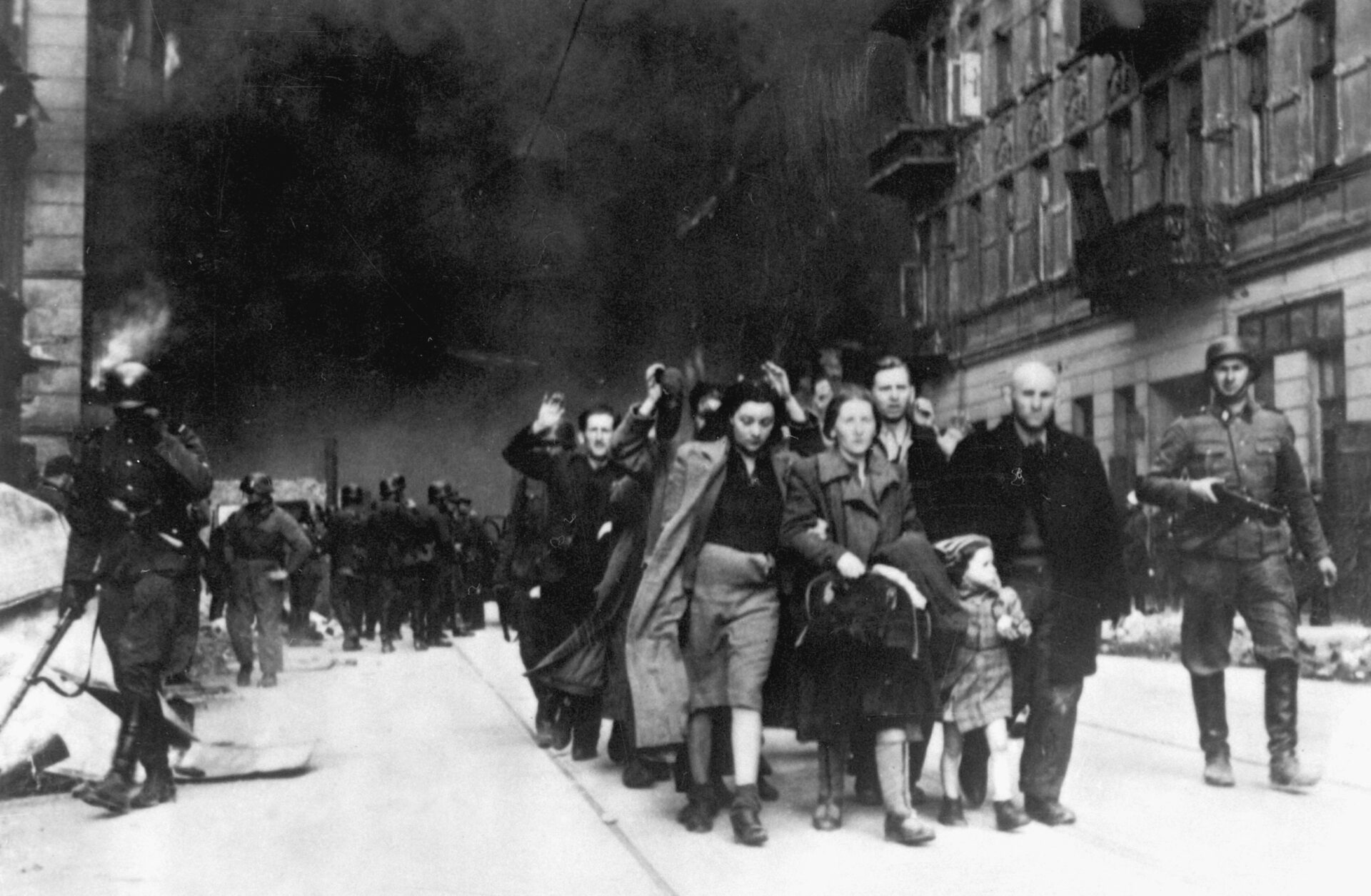
Urban Erasure: Cities like Warsaw, Minsk, and Stalingrad were reduced to rubble. Warsaw, following the 1944 Uprising, was 85% destroyed, with its cultural archives and historical libraries deliberately incinerated by Verbrennungskommandos (Burning Detachments).
IMAGE SUGGESTION 1
Subject: The Ruins of Warsaw (1945)
Description: A panoramic aerial photograph showing the “sea of ruins” in Warsaw. The image should depict the utter flattening of the city center, with only the skeletons of buildings remaining, illustrating the “urbicide” committed by German forces.
Caption: “Urbicide in the East: Warsaw was 85% destroyed, a level of destruction unparalleled in Western Europe.”
2.2. The Human Cost
The demographic losses in Eastern Europe were staggering. Poland lost approximately 17% of its pre-war population; the Soviet Union lost over 26 million people (both military and civilian); Yugoslavia lost over 1 million. These were not just collateral damages of combat but the result of targeted extermination policies.
3. The Holocaust and the Destruction of Jewish Civilization
The most irreversible consequence for Eastern Europe was the total annihilation of its Jewish population. Before 1939, Eastern Europe was the demographic and cultural heart of world Jewry.
3.1. The Industrialization of Death
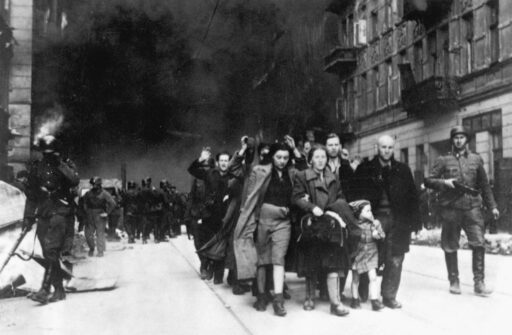
Unlike in the West, where Jews were often deported to camps in the East, the Holocaust in Eastern Europe began with the “Holocaust by Bullets.” Einsatzgruppen (mobile killing units) followed the Wehrmacht, executing over 1.5 million Jews in ravines and forests (e.g., Babi Yar in Ukraine, Ponary in Lithuania).
This evolved into the industrial slaughter of Operation Reinhard, utilizing extermination camps built exclusively on Polish soil (Bełżec, Sobibór, Treblinka). The result was a demographic void. The distinct Yiddishland culture—a blend of language, religion, and community structure that had existed for centuries—was extinguished.
IMAGE SUGGESTION 2
Subject: Einsatzgruppen Operations
Description: A historical photograph showing members of an Einsatzgruppe unit conducting mass executions in a forest setting (e.g., Ukraine or Lithuania). The image should be chosen carefully to be documentary but impactful, showing the “Holocaust by Bullets.”
Caption: “The Holocaust by Bullets: Before the gas chambers, mobile killing squads murdered over a million Jews in Eastern Europe.”
3.2. The Porajmos (Roma Genocide)
The Roma population of Eastern Europe also faced systematic extermination, known as the Porajmos. In the Independent State of Croatia (a Nazi puppet state), the Ustaše regime operated the Jasenovac concentration camp, where Serbs, Jews, and Roma were murdered with horrific brutality, leaving deep ethnic scars in the Balkans.
4. The Great Migration: Redrawing Borders and Populations
4.1. The Westward Shift of Poland
One of the most profound geopolitical consequences was the physical relocation of the Polish state. At the Tehran Conference (1943) and confirmed at Yalta (1945), the “Big Three” (Stalin, Roosevelt, Churchill) agreed to shift Poland’s borders westward.
-
Eastern Loss: Poland lost its “Kresy” territories (Vilnius, Lviv, Brest) to the Soviet Union (specifically to the Lithuanian, Ukrainian, and Belarusian SSRs).
-
Western Gain: In compensation, Poland received the “Recovered Territories” (Ziemie Odzyskane) from Germany: Silesia, Pomerania, and the southern part of East Prussia.
This shift, moving the country approximately 200 kilometers west, shortened Poland’s coastline but created a state that was, for the first time in centuries, ethnically homogeneous.
IMAGE SUGGESTION 3
Subject: Map of Poland’s Border Shift (1945)
Description: A dynamic map illustrating the “shift.” The pre-1939 Polish borders should be outlined in a faint color, while the post-1945 borders are solid. Arrows should indicate the loss of the Kresy to the USSR and the gain of the “Recovered Territories” from Germany.
Caption: “A State on Wheels: Poland was physically moved 200km west, losing its historic eastern cultural centers.”
4.2. The Expulsion of Germans (Vertreibung)
To accommodate this shift and satisfy Stalin’s desire for stability, a massive program of ethnic cleansing was authorized. Between 1944 and 1950, approximately 12 to 14 million ethnic Germans fled or were forcibly expelled from Eastern Europe (Poland, Czechoslovakia, Hungary, Romania).
-
Casualties: Estimates suggest anywhere from 500,000 to 2 million Germans died during the flight and expulsion due to cold, starvation, and Soviet reprisals.
-
Impact: The centuries-old German cultural presence in the East (e.g., Königsberg/Kaliningrad, Breslau/Wrocław) was erased.
IMAGE SUGGESTION 4
Subject: German Refugees (1945)
Description: A photograph of a column of German refugees fleeing westward in winter conditions, pulling carts with their belongings. The image captures the scale of the displacement known as the Vertreibung.
Caption: “The Great Displacement: Millions of ethnic Germans were expelled from the East, ending centuries of German settlement.”
5. The Sovietization of the East: From Liberation to Occupation
5.1. The “Salami Tactics” of Political Takeover
Stalin did not immediately impose full Soviet-style communism in 1945. Instead, local communist parties, guided by Moscow, employed what Hungarian communist leader Mátyás Rákosi called Salami Tactics: slicing off opposition parties one by one until only the communists remained.
-
Coalition Governments: Initially, “People’s Front” governments were formed, including non-communists.
-
Control of Interior Ministries: Communists invariably demanded control of the police and secret services (e.g., the UB in Poland, the StB in Czechoslovakia).
-
Rigged Elections: By 1947, elections were blatantly falsified (e.g., the Polish legislative election of 1947).
-
Liquidation: Opposition leaders like Stanisław Mikołajczyk (Poland) or Jan Masaryk (Czechoslovakia) were forced into exile, imprisoned, or murdered.
IMAGE SUGGESTION 5
Subject: Communist Propaganda Poster (Late 1940s)
Description: A propaganda poster from Poland or Hungary celebrating the “unity” of the Workers’ Party or the friendship with the Soviet Union. The imagery should feature red flags, industrial workers, and Stalin’s profile.
Caption: “Engineering Consent: Propaganda and rigged elections were used to legitimize the communist takeover.”
5.2. The Destruction of Civil Society
The Soviet NKVD and local security forces targeted the remnants of the pre-war intelligentsia, the church, and the non-communist resistance.
-
The Trial of the Sixteen: In 1945, leaders of the Polish Underground State were invited to negotiations by the Soviets, only to be arrested, flown to Moscow, and tried in a show trial.
-
Persecution of the Church: While initially cautious, regimes eventually targeted the Catholic and Orthodox churches (e.g., the arrest of Cardinal Mindszenty in Hungary).
6. Resistance in the Forests: The Anti-Soviet Insurgencies
Contrary to the narrative that the war ended in May 1945, a brutal guerilla war continued in Eastern Europe well into the late 1940s and early 1950s.
-
The Cursed Soldiers (Poland): Members of the disbanded Home Army (Armia Krajowa) formed anti-communist units like Freedom and Independence (WiN), fighting the NKVD and Polish communist forces.
-
The Forest Brothers (Baltics): In Estonia, Latvia, and Lithuania, thousands of partisans waged a desperate war against Soviet re-occupation, hoping for Western intervention that never came.
-
The UPA (Ukraine): The Ukrainian Insurgent Army fought both the Germans and the Soviets, continuing a large-scale insurgency in Western Ukraine until the early 1950s.
IMAGE SUGGESTION 6
Subject: The Cursed Soldiers / Forest Brothers
Description: A photograph of anti-communist partisans in a forest camp (Poland or Lithuania) post-1945. They are often wearing mixed uniforms and holding diverse weaponry, representing the desperate, forgotten resistance.
Caption: “The War After the War: Anti-Soviet partisans, like Poland’s ‘Cursed Soldiers,’ fought on for years after VE Day.”
7. Economic Transformation and Exploitation
7.1. Dismantling and Reparations
The Soviet Union viewed Eastern Europe not just as a buffer zone but as a resource for its own reconstruction.
-
Trophy Brigades: Soviet units dismantled thousands of factories in the Soviet occupation zone of Germany and in “liberated” Manchuria, but also stripped industrial assets from Poland and Hungary, shipping them to the USSR.
-
Coal Tribute: Poland was forced to sell coal to the Soviet Union at prices roughly 10% of the world market value, a form of colonial extraction dubbed “coal tribute.”
7.2. Nationalization and Central Planning
By 1948, the private sector had been effectively liquidated.
-
Land Reform: Large estates were broken up. Initially redistributed to peasants to gain political support, the land was later collectivized (forced into collective farms like kolkhozes), destroying the traditional peasantry.
-
Rejection of the Marshall Plan: In 1947, under pressure from Stalin, Poland and Czechoslovakia were forced to reject the American Marshall Plan aid. Instead, they were integrated into the Molotov Plan (later COMECON), binding their economies to the Soviet sphere and ensuring technological stagnation relative to the West.
IMAGE SUGGESTION 7
Subject: Reconstruction of Warsaw/Berlin
Description: Women (Trümmerfrauen) and workers clearing rubble and rebuilding using manual labor. This contrasts with the machinery-aided reconstruction in the West, highlighting the economic disparity.
Caption: “Reconstruction without Aid: Forced to reject the Marshall Plan, Eastern Europe rebuilt slowly under Soviet economic constraints.”
8. The Yalta Betrayal and the Iron Curtain
8.1. The Diplomatic Seal
The Yalta Conference (February 1945) is often viewed in Eastern Europe as the moment of “Western Betrayal.” While Roosevelt and Churchill secured Stalin’s promise for “free and unfettered elections” in Poland, they lacked the leverage (or the will, in Roosevelt’s case) to enforce it. The reality of the Red Army’s boots on the ground dictated the political outcome.
IMAGE SUGGESTION 8
Subject: The Yalta Conference Big Three
Description: The famous photo of Churchill, Roosevelt, and Stalin sitting together at Yalta. Their expressions should be visible.
Caption: “The Architects of Division: At Yalta, the fate of Eastern Europe was decided by the Great Powers, often over the heads of the nations involved.”
8.2. Churchill’s Warning
On March 5, 1946, Winston Churchill declared in Fulton, Missouri: “From Stettin in the Baltic to Trieste in the Adriatic, an iron curtain has descended across the Continent.” This metaphorical barrier became a physical reality, consisting of barbed wire, minefields, and watchtowers, sealing Eastern Europe off from the cultural and economic life of the West for nearly half a century.
IMAGE SUGGESTION 9
Subject: The Iron Curtain Map
Description: A political map of Cold War Europe (circa 1949). The NATO countries should be blue, the Warsaw Pact countries red, and a thick black line representing the Iron Curtain running through Germany and down to the Adriatic.
Caption: “The Great Divide: The Iron Curtain split the continent, isolating Eastern Europe for 45 years.”
9. Conclusion: The Legacy of the “Kidnapped West”
The consequences of 1939–1945 for Eastern Europe were foundational. The region did not simply “recover” from the war; it was fundamentally reinvented.
-
Ethnic Homogeneity: The multi-ethnic tapestry of the interwar period (Jews, Germans, Poles, Ukrainians living side-by-side) was replaced by ethnically homogeneous nation-states through genocide and expulsion.
-
Geopolitical Alignment: The region was forcibly pivoted from being the eastern periphery of Western culture to the western periphery of the Soviet empire.
-
Psychological Trauma: The “double occupation” left a deep legacy of distrust toward both Germany and Russia, as well as a lingering sense of abandonment by the Western Allies.
The Czech writer Milan Kundera later described this region as the “Kidnapped West”—culturally Western nations trapped in a Soviet geopolitical nightmare. The events of 1939 were the abduction; the period of 1945–1989 was the captivity.
IMAGE SUGGESTION 10
Subject: The Berlin Wall / Border Fence
Description: A photo of the fortified inner German border or the early Berlin Wall construction. It symbolizes the final solidification of the division that began with the Molotov-Ribbentrop Pact.
Caption: “Concrete and Barbed Wire: The physical manifestation of the political division that began in 1939.”
References and Further Reading
-
Book: Applebaum, Anne. Iron Curtain: The Crushing of Eastern Europe, 1944-1956. Doubleday.
-
Book: Snyder, Timothy. Bloodlands: Europe Between Hitler and Stalin. Basic Books.
-
Book: Judt, Tony. Postwar: A History of Europe Since 1945. Penguin Press.
-
Book: Lowe, Keith. Savage Continent: Europe in the Aftermath of World War II. St. Martin’s Press.
-
Archive: The Wilson Center. Cold War International History Project: Origins of the Cold War.
-
Article: US Holocaust Memorial Museum. The Holocaust in Poland.
-
Academic Paper: Ther, Philipp. The Integration of Expellees in Germany and Poland after World War II. East European Politics and Societies.
-
Digital Resource: CVCE.eu by University of Luxembourg. The division of Europe.
-
Book: Gross, Jan T. Fear: Anti-Semitism in Poland After Auschwitz. Random House.
-
Treaty Text: Yale Law School. The Yalta Conference Agreements.