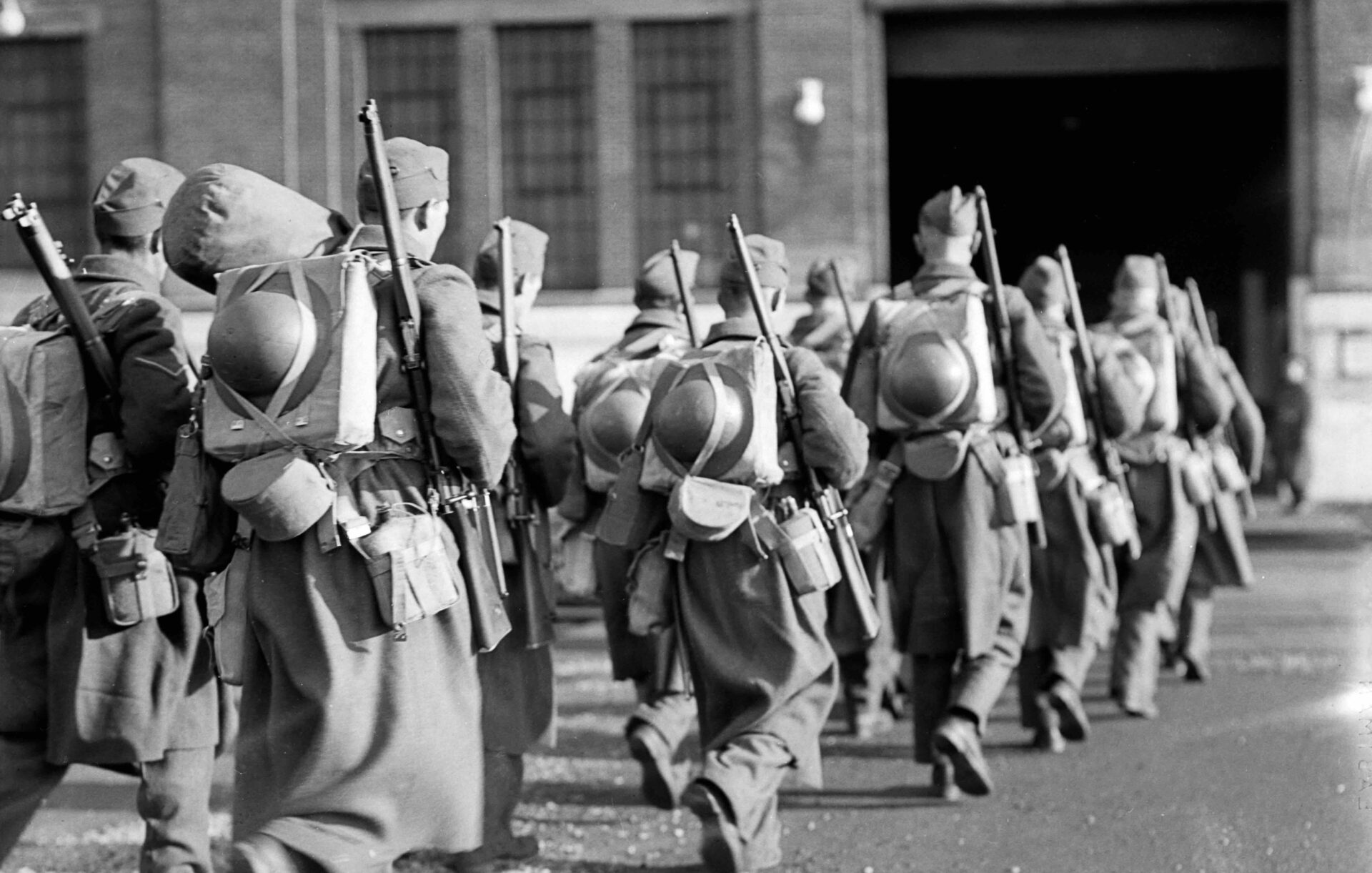

The Phoney War: Strategic Paralysis, Diplomatic Failure, and the Illusion of Safety (1939–1940)
Executive Summary
The eight-month interlude between the fall of Poland in September 1939 and the German invasion of France in May 1940, historically labeled the “Phoney War” (or Sitzkrieg by the Germans, Drôle de guerre by the French), represents one of the most enigmatic and catastrophic periods in modern military history. Often dismissed in popular narratives as a period of uneventful boredom, it was, in reality, a critical phase of frantic strategic realignment, industrial mobilization, and fatal doctrinal miscalculation. While the Western Allies (Britain and France) embraced a doctrine of static containment and long-term economic blockade, believing time was an asset that favored their superior resources, Nazi Germany utilized this operational pause to analyze the tactical lessons of the Polish campaign, overhaul its armored doctrine, and prepare the logistical groundwork for the devastating Manstein Plan. This article dissects the military, political, economic, and psychological dimensions of this deceptive calm, arguing that the “Phoney War” was not a period of peace, but the quiet assembling of the guillotine that would sever the head of the French Third Republic.
1. Introduction: The Sound of Silence and the Trauma of Memory
On September 3, 1939, following the expiry of the British ultimatum to Germany regarding the invasion of Poland, air raid sirens wailed over London. Civilians, conditioned by the terrifying predictions of interwar theorists like Giulio Douhet and H.G. Wells, expected immediate, apocalyptic aerial bombardment. The British government had already distributed millions of cardboard coffins and prepared mass graves, anticipating hundreds of thousands of casualties in the first week alone. Yet, the skies remained clear.
For the next eight months, the Western Front—the scar of Europe where millions had perished in the mud between 1914 and 1918—remained largely quiet. There were no grand offensives, no mass gas attacks, and minimal movement. This inactivity presented a surreal paradox: a declared “Total War” devoid of major combat. American Senator William Borah famously dubbed it “The Phoney War,” a term that stuck in the Anglosphere. However, beneath the surface of this stagnation, a complex chess game of maritime warfare, espionage, and an industrial race was underway.
The inactivity was rooted in the trauma of the First World War. The French military leadership, particularly General Maurice Gamelin, was obsessed with avoiding a repeat of the demographic catastrophe of 1914-1918, where France lost a generation of young men. Consequently, the Allied strategy was fundamentally defensive: maintain the integrity of the borders, strangle the German economy through naval blockade, and wait for the full mobilization of British imperial resources and potential American industrial support. They believed they were fighting a war of attrition (guerre d’usure). They failed to realize that their adversary had developed a doctrine—Blitzkrieg—specifically designed to bypass static defenses and avoid attrition entirely.
2. The Saar Offensive: Western Betrayal of Poland and Doctrinal Timidity
The most glaring evidence of Western inactivity occurred mere days after the declaration of war. Under the Franco-Polish Military Alliance of 1921, specifically the military convention of 1939, France was legally and morally obligated to launch a “major offensive” against Germany within 15 days of mobilization to relieve pressure on Poland.
2.1. Operational Details of the Saar Offensive
On September 7, 1939, the French Army initiated the Saar Offensive. The operation involved the French 2nd Army Group under General André-Gaston Prételat. In theory, the French possessed an overwhelming numerical superiority on the Western Front at this specific moment. The German First Army, commanded by Erwin von Witzleben, had no tank divisions and very few reserves, as the entire armored might of the Wehrmacht was engaged in the East, crushing Poland.
-
French Strength: Approximately 40 divisions, 2,400 tanks, and 4,700 artillery pieces were available for the sector.
-
German Weakness: The Germans were defending with fewer than 22 undermanned infantry divisions and zero armor. Their “Westwall” (Siegfried Line) fortifications were far from complete in this sector.
2.2. The Advance and the Halt
French troops advanced cautiously, penetrating about 8 kilometers into German territory. They captured 12 evacuated villages (including Saarbrücken’s outskirts) and the Warndt Forest. However, the advance was conducted with extreme hesitation. French doctrine dictated that tanks should not operate independently but must be tethered to infantry support. Furthermore, they were terrified of German mines and booby traps.
Upon encountering the first substantial line of German defenses and heavy machine-gun fire, General Gamelin ordered a halt on September 12. He issued a secret instruction: “Do not approach the Siegfried Line.” By October, as Poland capitulated, Gamelin ordered a complete and secret withdrawal. The French army returned to the safety of the Maginot Line without fighting a single major battle. This retreat was not just a military failure; it was a political betrayal that signaled to Stalin and Hitler that the Western Allies had no stomach for offensive warfare.
IMAGE SUGGESTION 1
Subject: French Troops in the Saar
Description: A photograph of French soldiers cautiously patrolling a deserted German village in the Saarland, September 1939. The lack of combat and the tentative nature of the advance should be visible.
Caption: “The Token Offensive: French troops advanced only a few kilometers into Germany before retreating, sealing Poland’s fate.”
3. The Maginot Mentality: Fortress France and Engineering Hubris
The primary driver of the Phoney War’s stagnation was the French reliance on the Maginot Line. Constructed in the 1930s at a colossal cost of 3 billion francs, this line of concrete fortifications, underground railways, and retractable turrets stretched from the Swiss border to Luxembourg.
3.1. Technical Specifications of the Line
The Maginot Line was a marvel of defensive engineering, far superior to anything constructed in WWI. It consisted of massive “Ouvrages” (fortresses) connected by underground tunnels.
-
Firepower: The forts were equipped with 75mm and 135mm retractable turret guns, machine gun cloches, and anti-tank ditches.
-
Self-Sufficiency: The larger forts, like Ouvrage Hackenberg or Hochwald, were essentially buried cities. They had their own diesel power plants, electric train systems for ammunition transport, hospitals, air filtration systems against poison gas, and barracks for hundreds of men.
-
Strategic Blind Spot: The line stopped at the Belgian border. This was a deliberate political and strategic decision: extending it would have signaled that France was abandoning Belgium to Germany, and the high water table in Flanders made construction difficult. The Allies assumed the Germans would have to attack through Belgium (as in the Schlieffen Plan), where the French and British armies would meet them in open battle.
3.2. The Psychological Shield
The Line acted as a “shield” without a “sword.” It absorbed a massive percentage of the French military budget and, more importantly, fostered a defensive psychology known as the “Maginot Mentality.” French commanders believed the Line made France impenetrable. This led to a dangerous complacency. Training exercises were neglected in favor of manning the forts. Soldiers spent the Phoney War playing cards, drinking wine, and rotting in the damp underground bunkers, leading to a degradation of morale and physical fitness.
IMAGE SUGGESTION 2
Subject: Maginot Line Cross-Section
Description: A technical diagram or cutaway drawing showing the underground complexity of a Maginot fort (Ouvrage). Showing the living quarters, ammunition stores, and electric trains deep underground.
Caption: “The Illusion of Security: The sophisticated underground network of the Maginot Line created a false sense of impregnability.”
4. The War at Sea: The Real Conflict and Technical Innovation
While the land front was stagnant, the war at sea was immediate, brutal, and technologically sophisticated. The Phoney War did not exist in the Atlantic. This period saw the first critical engagements of the Battle of the Atlantic.
4.1. The U-Boat Threat and Asymmetric Warfare
Germany, knowing it could not match the Royal Navy in surface tonnage (Plan Z was years from completion), turned to asymmetric warfare using U-boats (Submarines). Admiral Karl Dönitz, commander of the U-boat fleet, advocated for the Rudeltaktik (Wolf Pack tactics), though he lacked enough boats in 1939 to fully implement it.
-
SS Athenia: On the very first day of the war, U-30 sank the passenger liner SS Athenia, killing 117 civilians. This signaled that unrestricted submarine warfare, a major issue in WWI, would return immediately.
-
HMS Royal Oak: In October 1939, Gunther Prien’s U-47 infiltrated the supposedly impenetrable Scapa Flow naval base through a gap in the blockships. He sank the battleship HMS Royal Oak, killing 833 sailors. This was a massive propaganda blow to the British Admiralty and forced the Home Fleet to disperse to safer, but less strategic, ports.
4.2. The Magnetic Mine Crisis
One of the most dangerous German innovations during this period was the magnetic influence mine. Unlike contact mines, these sat on the seabed and detonated when the magnetic field of a steel ship passed overhead.
-
The Threat: These mines were sinking ships in vital estuaries like the Thames, and the British initially had no countermeasure.
-
The Solution: After recovering a mine dropped on mudflats, British scientists developed “Degaussing”—running an electric cable around the hull of a ship to neutralize its magnetic field. This was one of the first major technical victories of the war.
4.3. The Battle of the River Plate
The first major surface engagement of the war occurred in the South Atlantic in December 1939. The German “pocket battleship” (Panzerschiff) Admiral Graf Spee had been raiding merchant shipping. Pursued by three British cruisers (HMS Exeter, Ajax, and Achilles), the German captain Hans Langsdorff was cornered in Montevideo, Uruguay.
-
Tactical Analysis: The battle demonstrated the superiority of British radar and fire control, even against heavier German guns. Graf Spee’s 11-inch guns inflicted heavy damage, but the lighter British cruisers outmaneuvered her.
-
Outcome: Believing he faced a superior force (due to British deception), Langsdorff scuttled his ship. It was a major morale boost for the British public, desperate for “good news” amidst the inactivity at home.
IMAGE SUGGESTION 3
Subject: The Scuttling of the Graf Spee
Description: A dramatic photo of the Admiral Graf Spee burning and sinking in the River Plate estuary off Montevideo. Smoke billowing into the sky.
Caption: “Victory at Sea: The scuttling of the Graf Spee provided the first major Allied triumph of the war.”
5. The Winter War: A Distraction in the North
During the Phoney War, the world’s attention shifted to Scandinavia. On November 30, 1939, the Soviet Union, emboldened by the spheres of influence granted by the Molotov-Ribbentrop Pact, invaded Finland.
5.1. David vs. Goliath: Tactical Implications
The Winter War (Talvisota) exposed the severe deficiencies of the Red Army. The Soviets attempted to use heavy mechanized columns on narrow forest roads. Finnish troops, using Motti tactics (encirclement and piecemeal destruction), annihilated entire Soviet divisions (e.g., at the Battle of Suomussalmi).
-
Equipment Failure: Soviet T-26 and BT tanks proved vulnerable to Molotov cocktails and the harsh terrain. The Red Army’s leadership purge was evident in the incompetence of its officer corps.
-
Strategic Misinterpretation: The Red Army’s poor performance convinced Hitler that the Soviet Union was “a colossus with feet of clay.” This directly accelerated his confidence in planning Operation Barbarossa.
5.2. The Allied Intervention Debacle
Britain and France seriously planned to send an expeditionary force to help Finland. However, the true motive was not humanitarian. The Allies aimed to seize the Swedish iron ore fields at Kiruna and the Norwegian port of Narvik, which supplied 40% of the German steel industry’s needs.
-
Operation Pike: There were even discussions of bombing Soviet oil fields in the Caucasus (Operation Pike), which would have brought the USSR into the war on Germany’s side—a potential strategic catastrophe for the Allies.
-
Outcome: Finland surrendered in March 1940 before the Allies could arrive. The failure to intervene in time caused the collapse of the French government of Édouard Daladier, replaced by Paul Reynaud.
IMAGE SUGGESTION 4
Subject: Finnish Ski Troops
Description: Finnish soldiers in white winter camouflage, on skis, armed with Suomi KP/-31 submachine guns, moving through a snowy forest.
Caption: “The White Death: Finnish resistance during the Winter War diverted global attention from the stalemate in the West.”
6. The Home Front: The “Bore War” and Social Strain
For the civilian population in Britain and France, the Phoney War was psychologically draining. It was referred to as the “Bore War.”
6.1. Civil Defense and Evacuation
The expectation of immediate bombardment led to drastic social engineering.
-
Operation Pied Piper: In Britain, 1.5 million children, pregnant women, and disabled people were evacuated from urban centers to the countryside in September 1939.
-
Social Friction: This mass migration exposed deep class divides. Middle-class rural hosts were often shocked by the poverty and hygiene of inner-city children, leading to social tension. When the bombs didn’t fall, a “drift back” occurred; by January 1940, nearly half of the evacuees had returned home, complacent and weary.
-
The Blackout: Strict blackout regulations caused thousands of road accidents. In the first month of the war, more Britons died in car accidents in the dark than in military action.
6.2. The “Confetti War” and Propaganda
Instead of high explosives, the Royal Air Force (RAF) dropped millions of propaganda leaflets (Nickels) over Germany. These pamphlets urged the German people to overthrow the Nazi regime, detailing the corruption of Nazi leaders and the inevitability of Allied victory.
-
Effectiveness: The press mocked this as the “Confetti War.” Air Marshal Arthur “Bomber” Harris later cynically remarked that the only thing the leaflets achieved was “to supply the Continent’s requirements of toilet paper for the five long years of war.” It revealed a fundamental misunderstanding of the grip the Nazi regime had on its population.
IMAGE SUGGESTION 5
Subject: The Blackout in London
Description: A night-time photo of Piccadilly Circus or a major London street in total darkness, perhaps with the faint outline of a bus or pedestrians with torches aimed at the ground.
Caption: “A City in Shadow: The strict blackout regulations were the most tangible sign of war for civilians during the quiet months.”
7. German Preparations: The Evolution of Plan Yellow
While the Allies waited, the Wehrmacht was frantically busy. The Phoney War was a gift of time that saved Germany from a potential disaster. The German High Command (OKH) used these months to completely reinvent their strategy.
7.1. Post-Poland Analysis and Refit
The campaign in Poland, while a victory, had exhausted German ammunition stocks. Nearly 50% of the tank force required repair or overhaul. The Wehrmacht needed months to restock. General Franz Halder initially feared that a French offensive in late 1939 would have collapsed the German front.
7.2. The Birth of the Manstein Plan
The original German plan for the invasion of France (Fall Gelb) was a predictable repeat of the WWI Schlieffen Plan—a massive sweep through northern Belgium.
-
The Incident: In January 1940, a German plane carrying the invasion plans crash-landed in Belgium (the Mechelen Incident). The Allies captured the plans, confirming their expectation that the attack would come through the north.
-
The Shift: This compromise forced Hitler to look for alternatives. General Erich von Manstein proposed a radical, high-risk plan: a thrust through the dense, hilly Ardennes forest (considered “impassable” for tanks by Allied planners) to Sedan.
-
The Trap: This plan turned the Allied strengths into weaknesses. By attacking through the center, the Germans would cut off the elite British Expeditionary Force (BEF) and French First Army, which would have rushed north into Belgium to meet the feint attack. The Phoney War gave Germany the essential time to adopt, refine, and logistically prepare this decisive stroke.
IMAGE SUGGESTION 6
Subject: German General Staff Planning
Description: A photo of Hitler looking at maps with Generals Manstein, Guderian, or Halder. They are pointing at the Ardennes region on the map.
Caption: “The Sickle Cut: During the lull, German strategists devised the plan to strike through the Ardennes, catching the Allies off guard.”
8. Economic Warfare and the Blockade Myth
The cornerstone of Allied strategy was the belief that Germany, resource-poor and lacking colonies, would collapse under economic blockade. The Ministry of Economic Warfare in London produced optimistic graphs showing German oil and rubber shortages.
8.1. The Soviet Lifeline
The Fatal Flaw: The Molotov-Ribbentrop Pact was not just a non-aggression treaty; it was a massive trade agreement. Throughout the Phoney War, Soviet trains delivered vital resources to Germany, effectively nullifying the British naval blockade.
-
Statistics: In 1940 alone, the USSR supplied Germany with 700,000 tons of oil, 1 million tons of grain, and huge quantities of manganese, chromium, and platinum. This Soviet aid allowed the Wehrmacht to stockpile the fuel and rubber necessary for the Blitzkrieg in the West.
8.2. Synthetic Solutions
Furthermore, Germany utilized the Phoney War period to ramp up its synthetic production. The I.G. Farben conglomerate increased the output of Buna (synthetic rubber) and synthetic fuel derived from coal liquefaction. By 1940, Germany was less dependent on imports than Allied intelligence estimated.
IMAGE SUGGESTION 7
Subject: Soviet Oil Trains to Germany
Description: A historical photo or a political cartoon showing Stalin feeding Hitler or trains crossing the border filled with supplies.
Caption: “The Blockade Breaker: Soviet supplies fueled the Wehrmacht during the Phoney War, undermining Allied economic strategy.”
9. The End of the Illusion: Operation Weserübung
The Phoney War effectively ended not in France, but in Scandinavia. On April 9, 1940, Germany launched Operation Weserübung, the invasion of Denmark and Norway.
9.1. Strategic Imperatives and Tactical Innovation
Hitler ordered the invasion to secure the iron ore shipping route from Narvik and establish naval bases in the North Atlantic to harass British shipping.
-
Airborne Assault: The operation saw the first major use of paratroopers (Fallschirmjäger) to capture key airfields in Denmark and Norway (e.g., Sola Air Station).
-
Naval Losses: The German Navy (Kriegsmarine) suffered heavy losses, including the heavy cruiser Blücher, sunk by antiquated Norwegian coastal guns in the Oslofjord. However, they succeeded in landing troops.
9.2. Allied Incompetence
An Anglo-French expeditionary force was sent to Norway (Narvik, Namsos), but it was a disaster. It was poorly coordinated, lacked air cover, and the troops lacked winter equipment (unlike the Germans, who had learned from the Winter War observations). The swift German conquest of Norway shocked the British public and exposed the incompetence of the Allied war leadership.
IMAGE SUGGESTION 8
Subject: German Troops in Copenhagen
Description: German soldiers marching past the equestrian statue of Christian V in Copenhagen or landing at Oslo airport. The juxtaposition of peaceful city life and invading troops.
Caption: “The End of Silence: The invasion of Denmark and Norway in April 1940 shattered the calm of the Phoney War.”
10. Political Fallout: The Norway Debate and the Fall of Chamberlain
The military failure in Norway triggered a political earthquake in London. It led to one of the most famous parliamentary sessions in British history: the Norway Debate (May 7-8, 1940).
10.1. “In the Name of God, Go!”
Prime Minister Neville Chamberlain, the architect of appeasement and the cautious strategy of the Phoney War, faced a rebellion from his own Conservative party.
-
Leo Amery’s Speech: Quoting Oliver Cromwell, MP Leo Amery pointed a trembling finger at Chamberlain and shouted: “You have sat too long here for any good you have been doing. Depart, I say, and let us have done with you. In the name of God, go!”
-
Lloyd George’s Intervention: The former WWI Prime Minister David Lloyd George also rose to devastatingly criticize Chamberlain, sealing his fate.
10.2. Churchill’s Ascent
On May 10, 1940—the very day Germany launched its invasion of France and the Low Countries—Neville Chamberlain resigned. Winston Churchill, the First Lord of the Admiralty and a long-time critic of appeasement, became Prime Minister. The era of inactivity was over; the era of “blood, toil, tears, and sweat” had begun. The timing was providential; Britain acquired a war leader just as the real war began.
IMAGE SUGGESTION 9
Subject: Winston Churchill Entering Downing Street
Description: The iconic photo of Churchill showing the V for Victory sign (or just wearing his Homburg hat) outside Number 10, May 1940.
Caption: “A New Leadership: The failures of the Phoney War led directly to the appointment of Winston Churchill as Prime Minister.”
11. Conclusion: The Price of Time
The Phoney War was a catastrophic strategic error for the Allies. They treated time as an ally, believing that every month of delay strengthened their armies and weakened Germany’s economy. The reality was the exact opposite.
-
German Gains: Germany used the time to perfect a revolutionary method of warfare, build up synthetic resource stockpiles, secure its northern flank in Scandinavia, and close its eastern flank via the Soviet pact.
-
Allied Losses: The Allies used the time to reinforce a WWI-style defensive line, sow confusion among their own populations, and allow their armies to stagnate in boredom.
When the storm finally broke on May 10, 1940, the French Army—considered on paper the finest in Europe, equipped with heavy Char B1 tanks and superior artillery—would collapse in just six weeks. The silence of the Phoney War was not peace; it was the quiet assembling of the guillotine. The failure to attack in 1939, when the German western border was weak, remains one of the greatest “what ifs” of military history.
IMAGE SUGGESTION 10
Subject: German Panzers Breaking Through (May 1940)
Description: A dynamic image of German Panzer columns (Panzer I and II) smashing through a border post or moving through the Ardennes forest, signaling the start of the Battle of France.
Caption: “The Storm Breaks: On May 10, 1940, the Sitzkrieg turned into Blitzkrieg, ending the illusion of safety.”
References and Further Reading
-
Strategic Analysis (Academic): Imlay, Talbot. Facing the Second World War: Strategy, Politics, and Economics in Britain and France 1938-1940. Oxford University Press. (This is the definitive work on the Allied strategy of “long war” during this period).
-
German Operational History: Frieser, Karl-Heinz. The Blitzkrieg Legend: The 1940 Campaign in the West. Naval Institute Press. (Official German history analyzing how they used the Phoney War to create the Manstein Plan).
-
French Perspective: Jackson, Julian. The Fall of France: The Nazi Invasion of 1940. Oxford University Press. (Crucial for understanding the “Maginot Mentality” and morale decay).
-
Naval History (U-Boats): Blair, Clay. Hitler’s U-Boat War: The Hunters, 1939-1942. Random House. (Detailed account of the early U-boat operations like Scapa Flow).
-
Primary Source (Parliament): Hansard 1803–2005. The Norway Debate (Conduct of the War), 7 May 1940. UK Parliament Archives. (The verbatim transcript of the debate that ended the Phoney War).
-
Diplomatic History: Carley, Michael Jabara. 1939: The Alliance That Never Was and the Coming of World War II. Rowman & Littlefield. (Explains the diplomatic failures preceding the stagnation).
-
Military Technology: Kaufmann, J.E. Fortress France: The Maginot Line and French Defenses in World War II. Pen & Sword Military. (Technical details on the fortifications).
-
Social History: Gardiner, Juliet. The Blitz: The British Under Attack. HarperCollins. (Includes excellent chapters on the “Bore War” and evacuation psychology).
-
American Perspective: Kennedy, David M. Freedom from Fear: The American People in Depression and War, 1929-1945. Oxford University Press. (Covers the US reaction to the “Phoney War” and isolationism).
-
Archive/Museum: Imperial War Museums (IWM). What Was The ‘Phoney War’?. (Primary artifacts and photos from the period).
-
Economic & Military Analysis: Tooze, Adam. The Wages of Destruction: The Making and Breaking of the Nazi Economy. Penguin Books. (Replaced the previous link: Detailed analysis of the Wehrmacht’s ammunition crisis and the economic necessity of the operational pause).