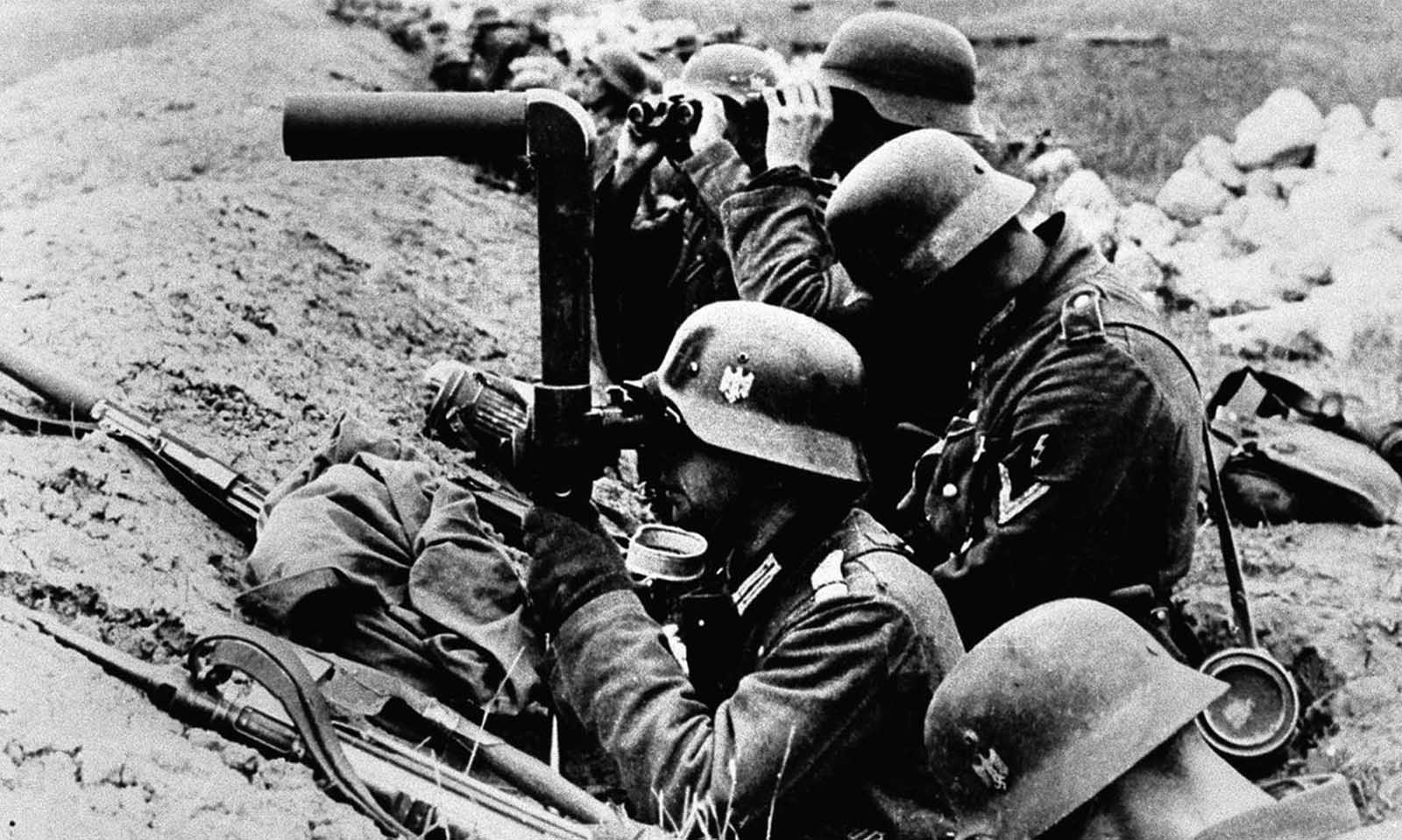

The War of Annihilation
When history looks back at the Second World War, the Western Front—with the D-Day landings and the liberation of Paris—often captures the popular imagination. However, the true engine of the war, the furnace where the fate of the Third Reich was ultimately decided, lay in the East.
The Eastern Front (known in Russia as the “Great Patriotic War”) was not merely a conflict over territory; it was a war of ideology and extermination. It pitted the racial dogmas of Nazi Germany against the communist resolve of the Soviet Union. It was the largest military confrontation in human history, characterized by unprecedented ferocity, wholesale destruction, and mass brutality.
More than 30 million people—soldiers and civilians—perished in this theater alone. Four out of every five German soldiers killed in WWII died fighting the Red Army. It was here, on the frozen steppes of Russia and the burning streets of Stalingrad, that the Wehrmacht’s back was broken.
This article explores the cataclysmic struggle from the initial shock of Operation Barbarossa to the final, blood-soaked fall of Berlin.
[IMAGE 1 PLACEHOLDER: A strategic map of the Eastern Front showing the maximum extent of the Axis advance in 1942, stretching from Leningrad in the north to the Volga River and the Caucasus in the south.]
Operation Barbarossa – The Storm Breaks (1941)
On June 22, 1941, Adolf Hitler unleashed “Operation Barbarossa.” It was the largest invasion force in history: 3.8 million Axis soldiers, over 3,000 tanks, and 2,700 aircraft poured across the Soviet border across a front spanning 1,800 miles.
Hitler believed the Soviet Union was a “rotten structure” that would collapse with a single kick. Initially, it seemed he was right. The Red Army, purged of its leadership by Stalin in the late 1930s, was caught completely unprepared.
The German advance was organized into three massive spearheads:
-
Army Group North headed for Leningrad.
-
Army Group Center aimed for Moscow.
-
Army Group South targeted the agricultural heartland of Ukraine and the oil of the Caucasus.
The Great Encirclements
The summer of 1941 was a season of disasters for the Soviet Union. Using Blitzkrieg tactics, German Panzers encircled vast Soviet armies at Minsk, Smolensk, and Kiev. At Kiev alone, over 600,000 Soviet soldiers surrendered. By October, the Germans were within sight of the spires of the Kremlin in Moscow.
However, the “kick” had not caused the collapse. Despite losing millions of men, the Red Army kept fighting. As autumn rains turned the roads to mud (Rasputitsa), the German advance slowed. Then came “General Winter.” Ill-equipped for sub-zero temperatures, the Wehrmacht froze at the gates of Moscow. In December 1941, a massive Soviet counter-offensive pushed the Germans back, proving that the Blitzkrieg could be stopped.
[IMAGE 2 PLACEHOLDER: German soldiers pushing a vehicle through thick mud during the ‘Rasputitsa’ season, highlighting the logistical nightmare of the Russian terrain.]
A War of Ideology and Terror
The Eastern Front was distinct from the war in the West because of the “Kommissarbefehl” (Commissar Order) and Generalplan Ost. Hitler viewed the Slavic people as Untermenschen (sub-humans) and Bolshevism as a Jewish conspiracy.
Behind the advancing Wehrmacht came the Einsatzgruppen—SS death squads tasked with rounding up and executing Jews, Romani people, and Soviet political officers. This “Holocaust by Bullets” resulted in the mass murder of over a million people in open fields and ravines, such as Babi Yar in Kiev.
Civilian suffering was unimaginable. The Siege of Leningrad (lasting 872 days) saw the city cut off from the world, leading to the starvation of over a million civilians. People were reduced to eating leather, glue, and in some horrific instances, engaging in cannibalism. This brutality galvanized Soviet resistance; surrender was not an option when the alternative was extermination.
[IMAGE 3 PLACEHOLDER: A stark black and white photo of the “Road of Life” across the frozen Lake Ladoga, with trucks carrying supplies into besieged Leningrad.]
The Turning Point – Stalingrad (1942–1943)
In 1942, blocked at Moscow, Hitler turned his attention south. “Case Blue” aimed to seize the oil fields of the Caucasus, vital for the German war machine. To protect the flank of this advance, the German 6th Army, under General Friedrich Paulus, had to capture the industrial city of Stalingrad on the Volga River.
Rattenkrieg (Rat War)
Stalingrad became a symbol for both dictators. Stalin issued Order No. 227: “Not one step back!” The battle descended into brutal urban warfare. Fighting took place not just street by street, but room by room, and sewer by sewer. The Luftwaffe reduced the city to rubble, but the rubble only created excellent defensive positions for Soviet snipers and infantry.
Operation Uranus
While the Germans slowly ground their way into the city, Marshal Georgy Zhukov prepared a trap. On November 19, 1942, the Soviets launched “Operation Uranus.” They smashed through the weak Romanian and Italian flanks protecting the German rear. Within days, the entire German 6th Army—over 250,000 men—was encircled.
Hitler forbade a breakout. The Luftwaffe failed to resupply the pocket by air. Starving and freezing, Paulus surrendered on February 2, 1943. It was the first time a German Field Marshal had ever surrendered. The myth of German invincibility was shattered.
[IMAGE 4 PLACEHOLDER: Soviet soldiers fighting amidst the ruins of a factory in Stalingrad, depicting the close-quarters intensity of urban warfare.]
[IMAGE 5 PLACEHOLDER: A long line of German POWs marching through the snow after the surrender at Stalingrad, stretching into the distance.]
The Greatest Tank Battle – Kursk (July 1943)
Stung by Stalingrad, the Germans launched one final major offensive in the summer of 1943: “Operation Citadel.” The objective was to pinch off a large Soviet bulge in the front line around the city of Kursk.
This time, there was no surprise. British codebreakers (Ultra) and Soviet intelligence had warned the Red Army. The Soviets built massive defensive belts—miles of minefields, anti-tank ditches, and artillery positions.
The Clash of Steel
When the Germans attacked with their new Tiger and Panther tanks, they ran into a wall of steel. The climax occurred at Prokhorovka on July 12, often cited as the largest tank battle in history. Hundreds of Soviet T-34s charged the German heavy armor at point-blank range to negate the German range advantage.
The German offensive stalled. For the first time in the war, a German summer offensive had failed. From this point on, the strategic initiative passed permanently to the Soviet Union. The Wehrmacht would be retreating for the rest of the war.
[IMAGE 6 PLACEHOLDER: A painting or colorized photo of the Battle of Kursk, showing Tiger tanks engaging T-34s on the open steppe amidst smoke and explosions.]
The Soviet Steamroller – Operation Bagration (1944)
By 1944, the Red Army had been transformed. It was no longer the disorganized force of 1941. It was a battle-hardened machine, supplied by American Lend-Lease trucks (Studebakers) and vast Soviet industrial output moved beyond the Urals.
On June 22, 1944—three years to the day after the German invasion and just weeks after the D-Day landings in France—the Soviets launched “Operation Bagration.”
Targeting Army Group Center in Belarus, the Soviets used Maskirovka (military deception) to fool the Germans into thinking the attack would come elsewhere. The result was catastrophic for Germany. The Soviet “Deep Battle” doctrine shattered the front. In just weeks, Army Group Center was annihilated, losing 28 divisions and 300,000 men (worse than Stalingrad). The Red Army advanced 400 miles, liberating Belarus and entering Poland.
[IMAGE 7 PLACEHOLDER: A column of Soviet T-34/85 tanks advancing rapidly through a Belarusian village, with soldiers riding on the back of the tanks.]
The Road to Berlin and the Fall of the Reich (1945)
By early 1945, the Red Army was on the Oder River, less than 50 miles from Berlin. The end was inevitable, but the fighting became even more desperate. The Germans, terrified of Soviet retribution for the crimes committed in the East, fought with the fury of the doomed.
The Battle of Berlin
In April 1945, 2.5 million Soviet troops under Marshals Zhukov and Konev launched the final assault. They smashed through the Seelow Heights and encircled Berlin. The city was defended by a mix of depleted Wehrmacht units, SS fanatics, and the Volkssturm (old men and boys).
The fighting in Berlin was apocalyptic. Soviet artillery pounded the city into dust. On April 30, as Soviet troops stormed the Reichstag building, Adolf Hitler committed suicide in his bunker.
On May 2, the iconic photograph of a Soviet soldier raising the Red Flag over the Reichstag was taken. The war in Europe ended shortly after, on May 8/9, 1945.
[IMAGE 8 PLACEHOLDER: The famous staged photo of a Soviet soldier raising the Soviet flag over the roof of the Reichstag building in Berlin, with the ruined city in the background.]
The Human Cost and Legacy
The statistics of the Eastern Front are numbing.
-
Soviet Union: Approximately 27 million dead (8.7 million military, 19 million civilian).
-
Germany: Over 4 million military dead (plus massive civilian casualties during the expulsion from the East).
-
Destruction: 1,700 Soviet towns and 70,000 villages were destroyed.
The Eastern Front defined the 20th century. It resulted in the destruction of the Nazi regime and the rise of the Soviet Union as a nuclear superpower. It also set the stage for the Cold War; the “Iron Curtain” fell roughly where the Red Army’s boots stopped.
To understand World War II, one must look East. It was there that the German war machine was ground to dust, and it was there that the greatest price for victory was paid.
[IMAGE 9 PLACEHOLDER: A map showing the division of Europe after the war, illustrating the “Iron Curtain” and the territories occupied by the Soviet Union.]
[IMAGE 10 PLACEHOLDER: A modern memorial statue, such as “The Motherland Calls” in Volgograd (formerly Stalingrad), symbolizing the immense sacrifice of the conflict.]
References and Recommended Sources
-
Glantz, David M. & House, Jonathan. When Titans Clashed: How the Red Army Stopped Hitler. University Press of Kansas, 2015. (Widely considered the definitive one-volume history of the Eastern Front from the Soviet perspective).
-
Overy, Richard. Russia’s War: A History of the Soviet War Effort: 1941-1945. Penguin, 1998. (An excellent analysis of the economic and political transformation of the USSR during the war).
-
Beevor, Antony. Stalingrad: The Fateful Siege: 1942-1943. Viking, 1998. (A gripping, narrative account of the turning point of the war).
-
Beevor, Antony. Berlin: The Downfall 1945. Viking, 2002. (A harrowing look at the final days of the Third Reich and the brutal behavior of the conquering armies).
-
Merridale, Catherine. Ivan’s War: Life and Death in the Red Army, 1939-1945. Metropolitan Books, 2006. (Focuses on the experience of the ordinary Soviet soldier).
-
Snyder, Timothy. Bloodlands: Europe Between Hitler and Stalin. Basic Books, 2010. (Examines the geopolitical and genocidal context of the lands where the war was fought).