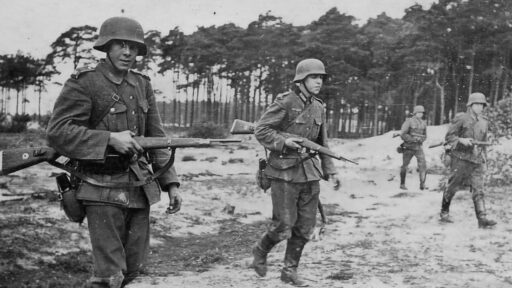

Introduction: The Face of the War
The popular image of the German Wehrmacht in World War II is often one of cold, mechanical efficiency—a faceless gray wall of steel rolling across Europe. However, the reality captured in the lenses of combat photographers tells a different story. It is a story not of machines, but of men pushed beyond the limits of physiological and psychological endurance.
Between 1939 and 1945, the German military machine was consumed by the very war it unleashed. The transformation is visible in the faces of its soldiers. The smiling, fresh-faced recruits of the early campaigns were rapidly replaced by the gaunt, hardened, and often traumatized visages of the Frontkämpfer (frontline fighters). This article explores the human dimension of the Wehrmacht’s operational history, analyzing how the “Invincible Army” coped with the shock of the Soviet Union, the brutality of partisan warfare, and the inevitable collapse of their logistical capabilities.
Part I: The Cult of the Elite – The Fallschirmjäger Myth
In the early years of the war, no unit personified the confidence of the Third Reich more than the Fallschirmjäger (Paratroopers). They were the “Knights of the Sky,” an all-volunteer force that saw themselves as superior to the regular army.
[Image File: Fallschirmjager Parade.jpg]
The image above captures the zenith of this morale. Parading through a captured town, likely in the early stages of the war, these men display the swagger of victors. Flowers adorn their tunics—a traditional German sign of victory and welcome. Their equipment is top-tier, their uniforms crisp. At this stage, the psychological burden of war was mitigated by the speed of their victories. They believed in their own invincibility.
However, this illusion was shattered during the invasion of Crete in May 1941. While a strategic victory, the Battle of Crete cost the airborne forces so many casualties that Hitler forbade future large-scale airborne operations. The “Hunters from the Sky” were grounded.
[Image File: Fallschirmjagers Chania Kreta.jpg]
Despite this, the esprit de corps remained. In the Mediterranean theater, particularly in Greece and later Italy, these troops adapted to a new role: elite light infantry. The photograph from Chania, Crete, shows them in their tropical uniforms. They are relaxed but alert, a tight-knit “band of brothers.” This unit cohesion (Kameradschaft) became the primary psychological defense mechanism. As the war turned against Germany, soldiers ceased fighting for ideology or the Führer; they fought simply to keep the man next to them alive.
Part II: The Eastern Front – The Psychological Breaking Point
If the Mediterranean was a war of elite infantry, the Eastern Front (Ostfront) was a descent into hell. Operation Barbarossa, launched in June 1941, exposed the Wehrmacht to a scale of warfare for which it was culturally and logistically unprepared.
[Image File: German Soldiers and Burning Soviet Tank on Eastern Front 1941.jpg]
The vastness of the steppe swallowed armies whole. The image of German infantry pinned down near a burning Soviet tank illustrates the lethality of the environment. Unlike the paved roads of France, the East was a landscape of dust, mud, and endless horizons. The psychological impact of the “endless space” (Unendlicher Raum) caused a specific type of depression among the troops, who felt they were marching into a void that never ended.
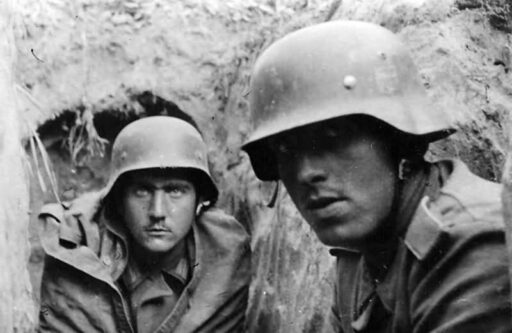
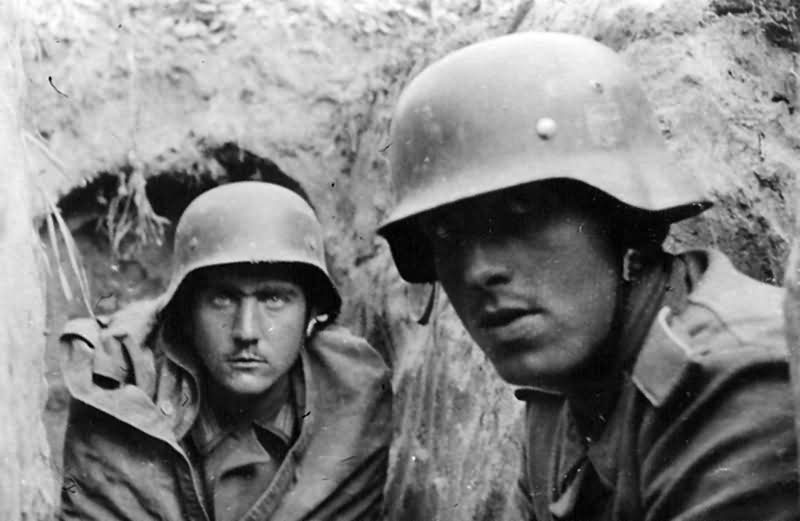
As the campaign dragged into autumn and winter, the physical toll became visible. The soldiers in the trenches near Kiev (pictured below) bear no resemblance to the paratroopers on parade.
[Image File: Battle Weary German Troops in Stahlhelm in Trench Kiev 1941 Eastern Front.jpg]
This is the “Thousand Yard Stare.” The eyes are wide, yet focused on nothing. The dirt on their faces is permanent, a mixture of sweat, oil, and the earth they sleep in. By late 1941, the German Landser was sleep-deprived, malnourished, and infested with lice. The war had ceased to be a maneuver of glory; it was a daily struggle for biological survival. The trench became their world, and the horizon was a place of death.
Combat in this environment was chaotic and industrial. The smoke-filled railyards and burning infrastructure became the natural habitat of the Wehrmacht soldier.
[Image File: Wehrmacht Soldiers in Action Eastern Front.jpg]
In such conditions, the only anchor for sanity was technical proficiency. The soldiers buried themselves in the mechanics of war.
Part III: Technology as a Shield – The Machine Gunner’s War
To survive against the numerical superiority of the Red Army, the Wehrmacht placed an almost religious reliance on their weaponry, specifically the machine gun. It was not just a tool for killing; it was a tool for psychological security.
[Image File: German Soldiers and Machine Gun Mg 34 With Optical Scope.jpg]
The image of the MG34 crew highlights this dependency. The gun is mounted on a Lafette tripod with a high-powered optical sight, turning it into a precision instrument capable of indirect fire. The gunner and his spotter are calm, professional technicians. For the German infantry squad, the rhythmic sound of their own machine gun was the sound of safety. As long as the MG was firing, the enemy heads were down, and the squad would live another hour.
Part IV: The Manpower Crisis and the “Hiwis”
By 1942 and 1943, the attrition rates in the East were unsustainable. The “pure Aryan army” of Nazi propaganda ceased to exist in reality. To keep the divisions fighting, the Wehrmacht began to rely on Hilfswillige (Hiwis)—”volunteer auxiliaries” recruited from Soviet POW camps and occupied territories.
[Image File: Wehrmacht Soldiers and Hiwi of Grenadier-Regiment 460 Eastern Front.jpg]
This photograph is historically significant. It shows German soldiers marching alongside a Hiwi (second from left), who is carrying ammunition boxes for the squad’s machine gun. These men often volunteered to escape the starvation of the POW camps, but many eventually fought with desperate loyalty, knowing that recapture by the Soviets meant execution.
The integration of Slavic auxiliaries into frontline German units—men whom the Nazi ideology deemed “subhuman”—is one of the great paradoxes of the Eastern Front. It demonstrates how the pragmatism of the frontline soldier overrode the ideology of the regime. When you need ammo carried, you don’t care about the carrier’s race; you care about his strength.
Part V: The Defensive Grind – Italy and the End
As the Soviet steamroller pushed from the East, the Western Allies struck at the “Soft Underbelly” of Europe—Italy. Here, the Fallschirmjäger once again found themselves in the thick of the fighting, but the context had changed completely. They were no longer conquerors; they were holding the line.
[Image File: Wehrmacht Troops Italy.jpg]
Even in the late stages of the war in Italy, attempts were made to maintain discipline and military bearing, as seen in the inspection photo above. However, the reality of the combat was brutal urban and mountain warfare.
[Image File: Fallschirmjager Italy 1944.jpg]
Fighting in the ruins of Italian towns, the German paratroopers utilized the rubble to their advantage. The photo of the Fallschirmjäger moving past bodies in a sun-drenched Italian street captures the lethality of the retreat. The “Fighting Withdrawal” became the standard operation. Every river crossing, every hill, and every farmhouse was turned into a defensive strongpoint to buy time.
By the winter of 1944-1945, the situation was hopeless. The final image of the paratroopers in the snow represents the end of the line.
[Image File: Fallschirmjager Paratroopers.jpg]
Clad in winter camouflage, holding their positions in a shattered building, these men are a far cry from the parading soldiers of 1940. They are hardened survivors, fighting a war that has long been lost strategically. The look on their faces is no longer one of arrogance, nor even fear—it is a grim resignation. They are waiting for the end.
Conclusion
The visual history of the Wehrmacht is a timeline of disintegration. It begins with the pristine uniforms and flowers of the early victories and ends in the mud, snow, and rubble of a destroyed continent. Through these photographs, we see the transformation of the German soldier from an instrument of aggressive conquest into a desperate survivor of a war of annihilation.
The tactical brilliance of the machine gun crews and the stubborn resistance of the paratroopers could delay, but not prevent, the inevitable outcome of a war fought against the world. In the end, the physical and psychological exhaustion seen in the eyes of the troops in Kiev and Italy mirrored the total collapse of the nation they fought for.
References and Recommended Sources
-
Fritz, S. G. (1995). Frontsoldaten: The German Soldier in World War II. University Press of Kentucky. Link to Publisher
-
Beevor, A. (1991). Crete: The Battle and the Resistance. John Murray. Link to Author’s Page
-
Citino, R. M. (2012). The Wehrmacht Retreats: Fighting a Lost War, 1943. University Press of Kansas. Link to Source
-
Snyder, T. (2010). Bloodlands: Europe Between Hitler and Stalin. Basic Books. Link to Book
-
Imperial War Museums (IWM). Life in the Infantry. Link to Website