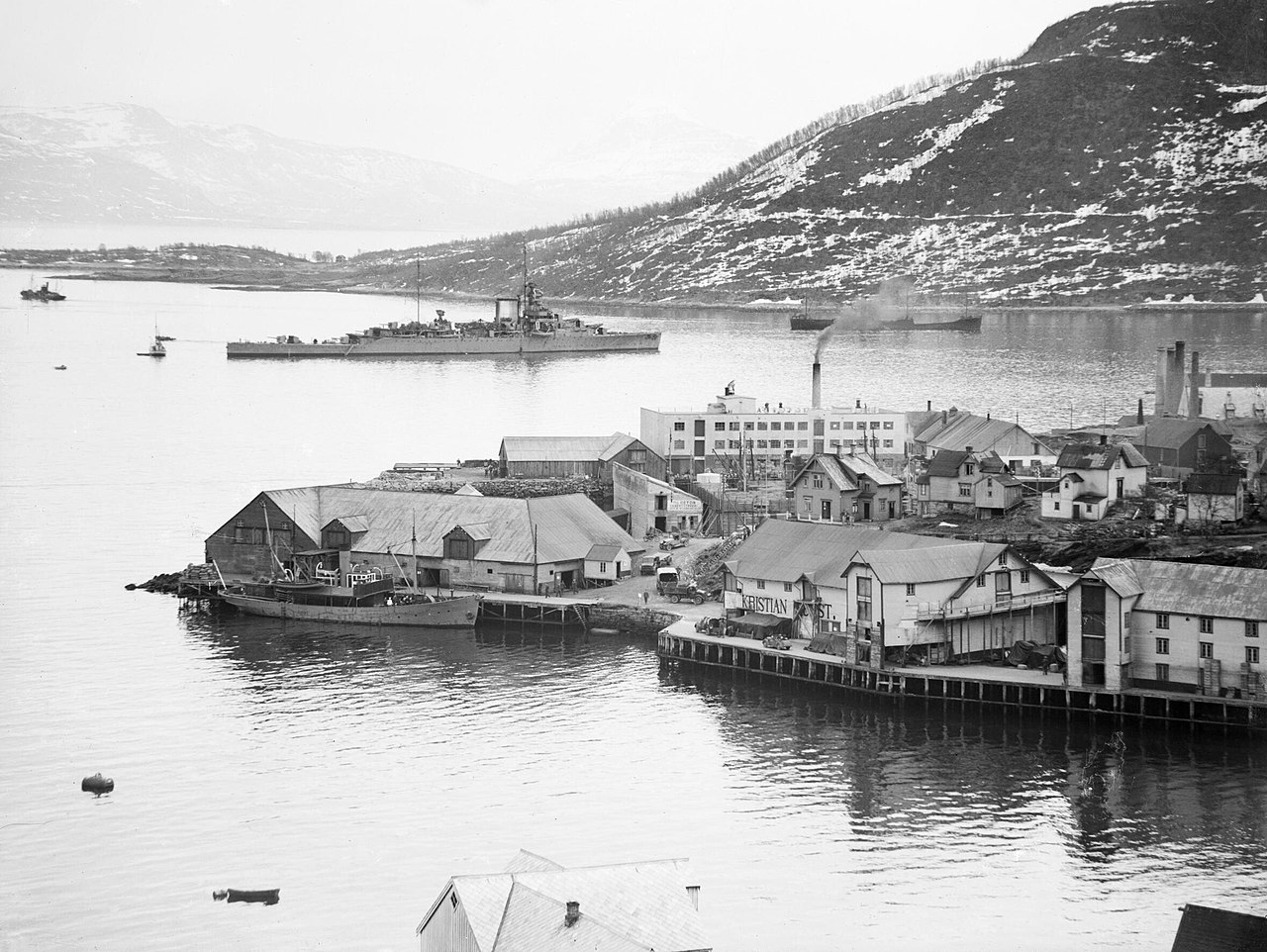

The Strategic Flank: The Norwegian Campaign’s Irreversible Impact on the Battle of the Atlantic, 1940–1945
Executive Summary
The German conquest of Norway in June 1940 was the pivotal geopolitical event that transformed the Battle of the Atlantic from a localized blockade into a hemispheric struggle. Prior to Operation Weserübung, the German Navy (Kriegsmarine) was geographically contained within the “Wet Triangle” of the North Sea, easily strangled by the Royal Navy at the Dover Straits and the Shetland-Norway gap. The occupation of Norway shattered this containment. It provided the Third Reich with a 1,500-mile coastline stretching beyond the Arctic Circle, effectively outflanking the British Isles.
This article provides a deep technical analysis of how this conquest revolutionized naval warfare. It examines the operational extension of U-boat ranges via forward bases (Trondheim/Bergen), the projection of long-range air power (Fw 200 Condors) to close the “Atlantic Gap,” the meteorological advantage gained by controlling the Arctic weather stations, and the strategic paralysis inflicted on the Royal Navy by the “Fleet in Being” doctrine. Ultimately, it argues that while Norway provided a tactical platform for the U-boat offensive, it eventually became a “strategic sinkhole,” absorbing critical manpower and resources into the static defense of “Fortress Norway.”
1. The Geopolitical Breakout: Escaping the Wet Triangle
For naval strategists, geography is the ultimate constraint. Great Britain’s survival depended on the North Atlantic supply lines, and historically, Britain utilized the “Geographic Advantage”: Germany had to pass through narrow choke points to reach the open ocean.
-
The Transit Problem: A Type VII U-boat departing from Kiel or Wilhelmshaven had to travel approximately 450 nautical miles just to reach the open North Sea, and then navigate the perilous passage between the Shetland Islands and Norway. This consumed valuable diesel fuel and crew endurance.
-
The Norwegian Solution: By seizing the Norwegian ports of Bergen and Trondheim, the Kriegsmarine reduced the transit distance to the operational zones of the North Atlantic by nearly 1,000 miles per sortie (round trip).
-
Force Multiplication: This reduction in transit time effectively increased the “time on station” for each U-boat. Operational analysis suggests that operating from Norway was mathematically equivalent to increasing the U-boat fleet size by 25% during the critical “Happy Time” of 1940–1941.
IMAGE SUGGESTION 1
Subject: Strategic Map of U-Boat Ranges
Description: A map contrasting the WWI naval situation (Germany bottled up) vs. the WWII situation (Germany controlling the Norwegian coast). The operational arcs of U-boats should be shown extending from Bergen and Trondheim, deeply overlapping the convoy routes west of Ireland.
Caption: “The Geopolitical Breakout: Bases in Norway allowed the Kriegsmarine to flank the British blockade, extending their operational reach deep into the North Atlantic.”
2. The Infrastructure of Aggression: The U-Boat Bunkers
Hitler and Grand Admiral Karl Dönitz wasted no time in fortifying their new prize. The Organisation Todt embarked on a massive engineering project to construct bomb-proof submarine pens (U-Boot-Bunker) along the Norwegian coast. These were not mere docks; they were reinforced concrete fortresses designed to withstand the heaviest Allied ordnance.
2.1. Bunker “Dora” (Trondheim)
Located in Trondheim, Dora I and Dora II became the northern hub for the 13th U-boat Flotilla.
-
Technical Specs: Dora I utilized over 45,000 cubic meters of reinforced ferro-concrete. Its roof was 3.5 meters thick, reinforced with steel beams to trigger bomb fuses before penetration. It could house 16 U-boats in seven dry/wet pens.
-
Strategic Function: Trondheim allowed U-boats to repair and refit safely, completely immune to RAF Bomber Command, which struggled to reach Central Norway with heavy payloads until late in the war.
2.2. Bunker “Bruno” (Bergen)
In Bergen, the Bruno bunker served the 11th U-boat Flotilla. The proximity to the Shetland-Norway gap meant U-boats could sortie into the Atlantic in hours rather than days. These bases forced the Royal Navy to maintain a permanent blockade patrol line further north, stretching their destroyer resources to the breaking point.
IMAGE SUGGESTION 2
Subject: U-Boat Bunker “Dora” Construction
Description: A historical photo of the massive concrete structure of Dora I under construction or in use. The sheer thickness of the concrete roof and the scale of the pens should be visible.
Caption: “Concrete Fortresses: The ‘Dora’ bunker in Trondheim provided an indestructible forward operating base for the 13th U-boat Flotilla.”
3. The Air-Sea Gap: The Focke-Wulf Condor Threat
The most immediate tactical impact of the Norwegian bases was the introduction of long-range aerial reconnaissance. The “Atlantic Gap” (the area of the ocean unreachable by land-based aircraft) was the traditional safe haven for U-boats. The Allies tried to close it; the Germans tried to exploit it.
3.1. KG 40 and the “Scourge”
Using captured airfields at Stavanger (Sola) and Trondheim (Værnes), the Luftwaffe deployed the Focke-Wulf Fw 200 Condor of Kampfgeschwader 40 (KG 40).
-
The Radius of Action: With a range of over 2,200 miles, Condors flying from Norway could loop around the British Isles, spot convoys west of Ireland, and radio their positions to the U-boat wolf packs.
-
Direct Attack: They also carried bombs. In early 1941, Condors sank 365,000 tons of Allied shipping—a tonnage comparable to the U-boats themselves during that period. Winston Churchill famously called the Condor “the scourge of the Atlantic.”
3.2. The Allied Response: CAM Ships
The threat of Norwegian-based Condors was so severe that the British developed CAM ships (Catapult Aircraft Merchantmen). These were merchant vessels fitted with a rocket catapult and a single Hurricane fighter. Once launched to intercept a Condor, the Hurricane could not land; the pilot had to bail out into the freezing Atlantic. This desperate tactic highlights the severity of the air threat radiating from Norway.
IMAGE SUGGESTION 3
Subject: Fw 200 Condor Patrol Routes
Description: A map showing the flight arcs of Condors from Bordeaux (France) and Stavanger (Norway), overlapping west of Ireland to close the “Air Gap.”
Caption: “The Scourge of the Atlantic: Operating from Norway, long-range Fw 200 Condors guided wolf packs to Allied convoys.”
4. The “Fleet in Being”: The Paralysis of the Royal Navy
While the German surface fleet suffered heavy losses during the invasion, the surviving heavy units were repaired and redeployed to Norwegian fjords. This created a strategic concept known as a “Fleet in Being”.
4.1. The Tyranny of the Tirpitz
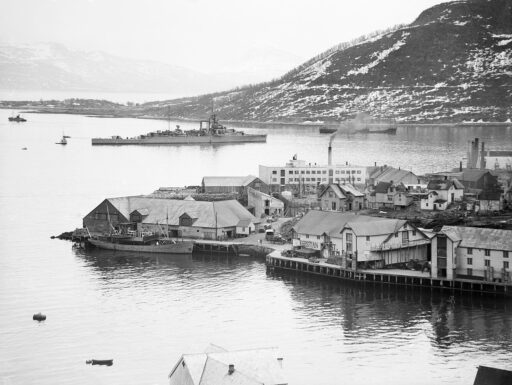
The battleship Tirpitz, sister ship to the Bismarck, spent most of the war anchored in Faettenfjord or Altafjord, protected by anti-torpedo nets and chemical smoke generators.
-
Strategic Paralysis: Tirpitz rarely fired her guns in anger. Yet, her mere presence in Norway forced the Royal Navy to keep two King George V-class battleships and at least one aircraft carrier permanently stationed at Scapa Flow.
-
The Resource Drain: These capital ships could not be deployed to the Mediterranean or the Pacific (where they were desperately needed against Japan) because if Tirpitz sortied, she could annihilate an entire convoy. The Allies launched over 20 separate operations to sink her, utilizing midget submarines (Operation Source) and heavy bombers (Operation Catechism).
IMAGE SUGGESTION 4
Subject: The Tirpitz in Altafjord
Description: An aerial reconnaissance photo showing the Tirpitz surrounded by torpedo nets, hidden deep within the steep walls of the fjord.
Caption: “The Lonely Queen: The mere presence of the Tirpitz in Norway tied down the Royal Navy’s capital ships for three years.”
5. The Arctic Convoys: The Murmansk Run
The most direct and brutal consequence of the German presence in Norway was the struggle for the Arctic Convoys. Following the German invasion of the Soviet Union (Operation Barbarossa) in 1941, the Western Allies committed to sending Lend-Lease supplies to Russia via the ports of Murmansk and Archangel.
5.1. The Geography of Death
To reach Murmansk, Allied convoys (codenamed PQ for outbound, QP for homebound) had to sail north of Norway.
-
The Gauntlet: They were forced to pass within range of the Luftwaffe bases at Banak and Kirkenes, and the Kriegsmarine naval bases at Altafjord. In winter, the pack ice forced ships south, closer to the German airfields. In summer, the “Midnight Sun” provided 24 hours of daylight, leaving ships with no cover from air attack.
5.2. Convoy PQ 17: The Ultimate Disaster
The strategic impact culminated in the disaster of Convoy PQ 17 in July 1942. Intelligence suggested Tirpitz, Hipper, and Scheer were sorting from Norway to intercept. First Sea Lord Dudley Pound ordered the convoy to “scatter.” Stripped of their destroyer escorts, the isolated merchant ships were picked off by U-boats and Luftwaffe Ju 88 bombers flying from Norway. 24 of the 35 merchant ships were sunk. This proved that as long as Germany held Norway, the Arctic route was a suicide run.
IMAGE SUGGESTION 5
Subject: Convoy PQ 17 Under Attack
Description: A dramatic painting or photo of merchant ships scattering amidst shell splashes and smoke, with a German Ju 88 bomber low overhead.
Caption: “The Gauntlet: Convoys sailing to Russia had to pass within minutes of German airfields in Northern Norway.”
6. The Intelligence War: Enigma and Coastal Watchers
The occupation of Norway also opened a new front in the intelligence war. The British Special Operations Executive (SOE) and the Norwegian Resistance established a network of coastal watchers that became the eyes of the Admiralty.
6.1. Human Intelligence (HUMINT)
Norwegian resistance members, often hiding in fishing huts with radio transmitters, reported the movement of every German ship entering or leaving the fjords. It was a Norwegian watcher in Kristiansand who first spotted the Bismarck heading north in May 1941, alerting the Admiralty and initiating the famous chase.
6.2. Signals Intelligence (SIGINT)
The heavy volume of radio traffic between the German naval command in Norway and Berlin provided Bletchley Park with a constant stream of Enigma intercepts (specifically the Hydra and later Triton cipher keys). This intelligence was crucial in routing convoys away from U-boat patrol lines that were being directed from Norwegian HQs.
IMAGE SUGGESTION 6
Subject: Norwegian Resistance Radio Operator
Description: A photo of a resistance member operating a clandestine radio set in a rustic cabin or cave.
Caption: “The Eyes of the Admiralty: Norwegian coastal watchers provided critical intelligence on German naval movements.”
7. The Weather War: Meteorology as a Weapon
Control of the North Atlantic weather reporting was a subtle but vital advantage gained by holding Norway.
-
The Westerlies: Weather systems in Europe generally move from west to east. By holding weather stations in Norway, Greenland, and Svalbard, the Germans could predict weather over the continent and the Russian front.
-
Wolf Pack Planning: Accurate forecasting from these high latitudes was essential for planning U-boat deployments. Both sides fought small, bitter skirmishes on remote Arctic islands solely to capture or defend these weather stations (Wettertrupp).
IMAGE SUGGESTION 7
Subject: German Weather Station in the Arctic
Description: A photo of a remote German weather station (Wettertrupp) in the snow, with meteorological equipment and armed personnel.
Caption: “The Weather War: Control of Norwegian outposts allowed Germany to predict weather patterns for the entire European theater.”
8. Technology and Counter-Measures: The Arms Race
The unique challenges of the Norwegian theater drove technological innovation. The need to detect U-boats emerging from Norwegian fjords accelerated the development of airborne radar (ASV Mk II) and shipborne High-Frequency Direction Finding (HF/DF or “Huff-Duff”).
8.1. The Leigh Light
To attack U-boats transiting from Norway at night on the surface (to recharge batteries), the RAF developed the Leigh Light—a powerful searchlight mounted on Wellington bombers. This turned the dangerous night transit into a death trap for U-boats.
8.2. The Schnorchel Response
In response to the Allied radar coverage over the transit routes from Norway, Germany accelerated the deployment of the Schnorchel (snorkel) in 1944. This technology allowed U-boats to run their diesel engines while submerged, a tactical shift largely driven by the impossibility of surfacing in the radar-saturated waters of the North Sea.
IMAGE SUGGESTION 8
Subject: Wellington Bomber with Leigh Light
Description: A photo of a Vickers Wellington showing the retractable Leigh Light ring under the fuselage.
Caption: “Turning Night into Day: The Leigh Light was developed to hunt U-boats transiting from Norwegian bases under cover of darkness.”
9. Strategic Overstretch: The “Festung Norwegen” Trap
While the naval advantages were clear, the long-term impact on the German war effort was arguably negative due to the massive commitment of manpower required to hold the coastline.
9.1. The Zone of Destiny
Hitler developed a “Zone of Destiny” obsession with Norway. He was convinced the Allies would launch an invasion there to cut off the iron ore. To prevent this, he declared “Festung Norwegen” (Fortress Norway).
-
The Atlantic Wall: The Organisation Todt poured millions of tons of concrete into coastal batteries (like the Batterie Vara in Kristiansand) to defend fjords that the Allies had no intention of attacking.
9.2. The Manpower Drain
By 1944, there were nearly 400,000 German troops stationed in Norway. These elite mountain and infantry divisions were essentially idle. During the D-Day landings in Normandy (1944) and the Battle of Berlin (1945), these forces were sitting in Norway, guarding against a phantom invasion. The strategic cost of “protecting” the U-boat bases eventually outweighed the tactical value of the bases themselves.
IMAGE SUGGESTION 9
Subject: Batterie Vara (Kristiansand)
Description: A photo of the massive 38cm gun barrel at the Møvik Fort (Batterie Vara).
Caption: “Guns Pointing Nowhere: Massive coastal defenses consumed concrete and manpower needed desperately on the Eastern Front.”
10. Conclusion: The Fatal Prize
The long-term impact of the Norwegian Campaign on the Battle of the Atlantic was a complex equation of tactical gains and strategic drains.
For Germany, the acquisition of Norway extended the U-boat arm’s reach and nearly severed the lifeline to Russia. It forced the Royal Navy to fight on a battlefield of Germany’s choosing for three years. However, the obsession with holding this prize diverted nearly half a million men and the remnants of the surface fleet into a strategic cul-de-sac.
For the Allies, the campaign was a painful lesson in the necessity of joint operations. The threat of the Norwegian bases forced the development of the convoy system and the technological marvels of anti-submarine warfare. Ultimately, the U-boat bases in Norway prolonged the Battle of the Atlantic, but the manpower trapped in “Fortress Norway” effectively shortened the war on the continent.
IMAGE SUGGESTION 10
Subject: German Troops Surrendering in Norway (1945)
Description: A photo of disciplined German troops surrendering in May 1945. They look well-fed and equipped, contrasting with the ragged troops elsewhere.
Caption: “The Unbeaten Army: 400,000 German troops surrendered in Norway in 1945, having spent the war guarding the Atlantic flank.”
References and Further Reading
-
Naval Strategy: Syrett, David. The Defeat of the German U-Boats: The Battle of the Atlantic. University of South Carolina Press. (Detailed analysis of the U-boat offensive from forward bases).
-
Bunker History: McNab, Chris. Hitler’s Fortresses: German Fortifications and Defenses 1939-45. Osprey Publishing. (Technical specs of Dora and Bruno bunkers).
-
Arctic Convoys: Woodman, Richard. Arctic Convoys 1941-1945. Pen & Sword. (Definitive history of the Murmansk run).
-
The Tirpitz Threat: Bishop, Patrick. Target Tirpitz. HarperCollins. (Analysis of the strategic paralysis caused by the ship).
-
Technical Data: Uboat.net. The Focke-Wulf Fw 200 Condor. (Operational history of the aircraft in the Atlantic).
-
Intelligence: Hinsley, F.H. British Intelligence in the Second World War. Cambridge University Press. (The role of Enigma and coastal watchers).
-
Primary Source: Churchill, Winston. The Second World War, Vol. 3: The Grand Alliance. (Churchill’s perspective on the Atlantic threat).
-
Strategic Analysis: Cohen, Eliot A. Supreme Command: Soldiers, Statesmen, and Leadership in Wartime. Free Press. (Discusses the diversion of troops to Norway).
-
Museum Resource: The Royal Navy Submarine Museum. The Battle of the Atlantic.
-
Operation PQ 17: The National Archives (UK). Convoy PQ 17 Inquiry Files.
-
Fortress Norway: Zabecki, David T. Germany at War: 400 Years of Military History. ABC-CLIO.
-
Meteorology: Selinger, Franz. Von Nanok bis Eismitte: Meteorologische Unternehmungen in der Arktis 1940-1945. (German Meteorological Operations in the Arctic).