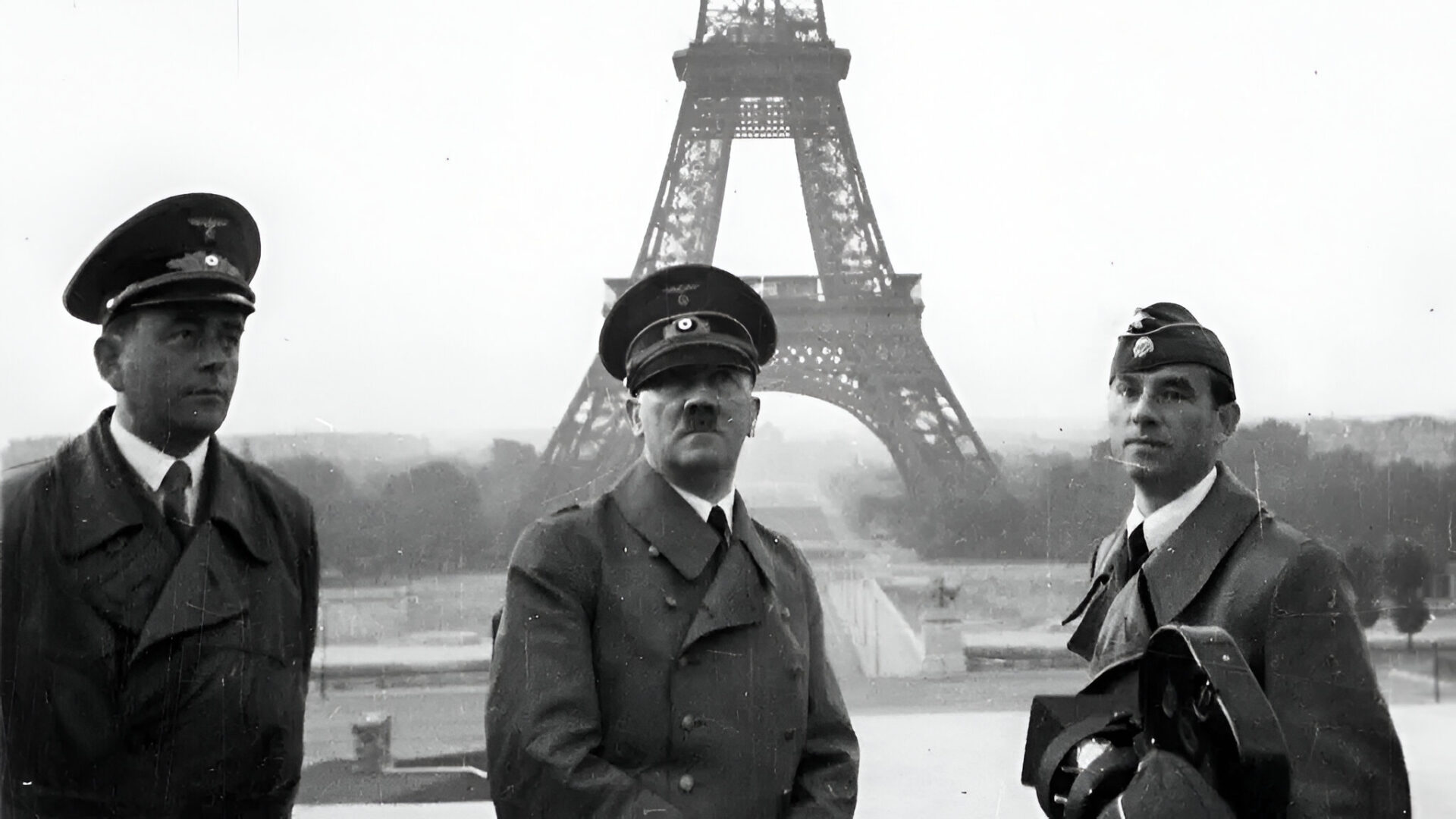

The Fall of France: Operational Shock and the Death of the Third Republic, May–June 1940
Executive Summary
The collapse of France in May and June 1940 remains the most profound “Operational Shock” of the 20th century. In a campaign lasting just six weeks, the German Wehrmacht dismantled the French Army—statistically the most powerful land force in Europe—and evicted the British Expeditionary Force (BEF) from the continent. This victory was not achieved through overwhelming material superiority, but through a revolutionary doctrinal asymmetry.
The campaign unfolded in two distinct phases: Fall Gelb (Case Yellow), the armored sickle cut through the Ardennes that encircled the Allied armies in Belgium, and Fall Rot (Case Red), the subsequent systematic destruction of the remaining French forces south of the Somme. This article dissects the technical failure of the French “Methodical Battle” doctrine, the operational brilliance of the Manstein Plan, the decisive role of C3I (Command, Control, Communications), and the political disintegration that led to the Armistice.
1. Introduction: The Illusion of Parity
On May 9, 1940, the balance of power on the Western Front appeared statistically even. The Allies (France, Britain, Belgium, and the Netherlands) fielded roughly 144 divisions against Germany’s 141. In terms of armor, the Allies possessed a quantitative and qualitative advantage, fielding ~3,200 tanks against Germany’s ~2,400.
The French High Command, led by General Maurice Gamelin, was confident. They believed the war would be a replay of 1914–1918: a static war of attrition where firepower and defensive fortifications would prevail. They had constructed the Maginot Line to economize force in the east, forcing the Germans to attack through the Belgian plain.
However, while France prepared for a linear defense, the Wehrmacht had developed a doctrine of high-tempo maneuver warfare (Bewegungskrieg), focusing on the Schwerpunkt (point of main effort) and decentralized execution (Auftragstaktik).
2. Strategic Geometry: The Manstein Plan vs. The Dyle Plan
The outcome of the campaign was largely decided before the first shot was fired, on the planning maps of the respective General Staffs.
2.1. The Allied Trap: Plan D (Dyle-Breda)
The Allied strategy was rigid. Upon a German invasion of Belgium, the French 1st Army and the British Expeditionary Force (BEF) would rush north to the Dyle River line to defend Brussels.
-
The Assumption: This plan assumed the main German effort would come through the Gembloux Gap in central Belgium, repeating the Schlieffen Plan.
-
The Strategic Error: By rushing their elite mobile units north, the Allies voluntarily stripped their center (the Ardennes sector) of reserves, leaving it defended by second-rate “Series B” infantry divisions lacking anti-tank capabilities.
2.2. The German Sickle: Sichelschnitt
After the Mechelen Incident compromised their original plans, General Erich von Manstein persuaded Hitler to adopt a radical alternative.
-
The Feint: Army Group B would launch a noisy attack in the north to draw the Allies into the Belgian trap.
-
The Strike: Army Group A, containing the bulk of the Panzer divisions (7 out of 10), would thread through the dense forests of the Ardennes, cross the Meuse River at Sedan, and drive west to the Channel coast. This “Sickle Cut” would sever the Allied supply lines and annihilate their best armies.
IMAGE SUGGESTION 2
Subject: Map of Fall Gelb Strategy
Description: A strategic map showing the Allied move into Belgium (Blue arrows) and the German thrust through the Ardennes (Red arrow), cutting them off.
Caption: “The Fatal Geometry: The Manstein Plan used the Allies’ own aggression against them, trapping their best forces in Belgium.”
3. The Decisive Breach: Sedan and the Meuse Crossing
The operational pivot point of the war occurred between May 12 and May 15 at the city of Sedan.
3.1. The “Impassable” Terrain
French intelligence believed it would take the Germans 9 to 14 days to traverse the Ardennes. General Heinz Guderian, commanding the XIX Panzer Corps, did it in 60 hours. Despite a traffic jam stretching 250km, the Allied air forces failed to interdict the columns.
3.2. The Assault (May 13, 1940)
Instead of waiting for heavy artillery, Guderian used the Luftwaffe as “flying artillery.”
-
Stuka Bombardment: For four hours, hundreds of Ju 87 Stukas dive-bombed French positions. The physical damage was limited, but the psychological impact on the reservist 55th Infantry Division was catastrophic (“The Panic of Bulson”).
-
The Crossing: Under cover of the air attack, German infantry crossed in rubber dinghies. By evening, combat engineers had built pontoon bridges, and the first tanks began to roll across. The French counter-attack on May 14 was slow, uncoordinated, and easily repulsed.
IMAGE SUGGESTION 3
Subject: Panzers Crossing the Meuse
Description: A photo of German Panzer IIs and IIIs crossing a pontoon bridge over the Meuse River near Sedan.
Caption: “The Pivot Point: German armor crossing the Meuse at Sedan on May 13 signaled the operational collapse of the French defense.”
4. Technical Analysis: Armor and the C3I Gap
A common myth is that German tanks were superior. In 1940, this was technically untrue regarding armor and firepower, but doctrinally false regarding ergonomics and command.
4.1. The Tank Matchup
-
French Char B1 bis: The pride of the French army. It had 60mm of frontal armor (invulnerable to the standard German 3.7cm anti-tank gun) and heavy armament.
-
German Panzer III/IV: Thinner armor (30mm) and lighter guns. In a duel, the Char B1 was superior.
4.2. The Fatal Flaw: Ergonomics and Radio
The French tank commander in a Char B1 was overwhelmed. He had to command the tank, load the gun, aim, and fire—all from a one-man turret.
-
The Radio Gap: Crucially, most French tanks lacked radios, communicating via signal flags. Once “buttoned up,” they fought as isolated bunkers. German tanks had radios in every vehicle. Guderian could direct his units like an orchestra. This C3I (Command, Control, Communications) advantage allowed the Germans to cycle through the OODA Loop (Observe-Orient-Decide-Act) faster than their opponents.
IMAGE SUGGESTION 4
Subject: Char B1 bis vs Panzer III Cutaway
Description: A technical diagram comparing the turret interiors. Showing the overworked French commander vs. the specialized German crew.
Caption: “Cognitive Overload: The French one-man turret overwhelmed the commander, while the German three-man turret optimized tactical efficiency.”
5. The Race to the Sea and the Arras Shock
Once across the Meuse, the German Panzers turned west, racing toward the English Channel.
5.1. The “Ghost Division”
General Erwin Rommel, commanding the 7th Panzer Division, advanced with such speed that he outran his own communications, engaging French heavy armor at Flavion and destroying the French 1st Armored Division by maneuvering around their supply lines.
5.2. The Battle of Arras (May 21)
The only significant Allied counter-attack occurred at Arras. British Matilda II tanks struck Rommel’s flank. Their thick armor was impervious to German anti-tank guns.
-
The 88mm Solution: Rommel improvised, using 88mm anti-aircraft guns in a direct-fire anti-tank role. This stopped the British attack, but the shock of Arras terrified the German High Command, leading directly to the cautious “Halt Order” outside Dunkirk.
IMAGE SUGGESTION 5
Subject: Flak 88mm Gun in Ground Role
Description: A photo of a German 88mm Flak gun deployed horizontally, engaging British tanks at Arras.
Caption: “The Improvisation: Rommel used 88mm anti-aircraft guns to stop the heavily armored British Matildas at Arras.”
6. Dunkirk: The Miracle of Deliverance
By May 20, Guderian’s tanks reached the coast at Abbeville. The Allied armies in the north were trapped.
6.1. Operation Dynamo
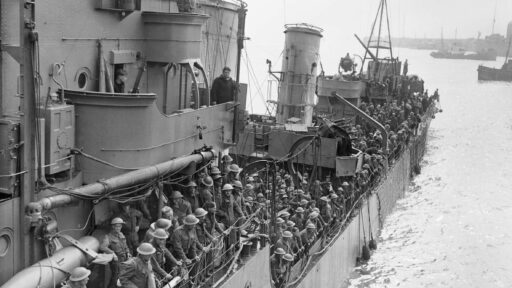
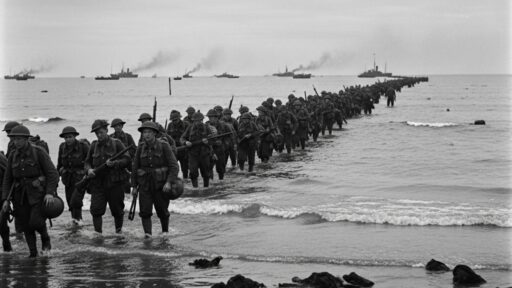
From May 26 to June 4, the Royal Navy, aided by civilian “Little Ships,” executed Operation Dynamo.
-
The Result: 338,000 Allied troops (including 110,000 French) were evacuated from the beaches.
-
The Strategic Cost: The BEF escaped, but it left behind all its heavy equipment: 2,472 guns, 65,000 vehicles, and 20,000 motorcycles. Britain saved its personnel but lost its army’s combat power for over a year.
IMAGE SUGGESTION 6
Subject: Dunkirk Evacuation
Description: A wide shot of the beaches of Dunkirk, lines of soldiers waiting in the water, with smoke from burning oil tanks in the background.
Caption: “The Miracle of Deliverance: Over 338,000 troops escaped the German trap, preserving the core of the British Army.”
7. The Air War: Luftwaffe Supremacy
The Battle of France was also a brutal air war. The Luftwaffe established air superiority through operational tempo.
-
Sortie Rates: German pilots flew up to four missions a day, operating from captured forward airfields. Allied pilots, hampered by chaotic logistics, often flew only one.
-
Close Air Support: The Luftwaffe functioned as “flying artillery,” directly supporting Panzer spearheads, whereas the French Air Force was often held back to defend cities, diluting its impact.
IMAGE SUGGESTION 7
Subject: Ju 87 Stuka
Description: A Stuka dive bomber in a steep dive, sirens wailing (visualized by speed lines or context).
Caption: “Flying Artillery: The Stuka provided the Panzers with immediate, precision fire support, replacing slow-moving heavy artillery.”
8. Fall Rot: The Final Collapse
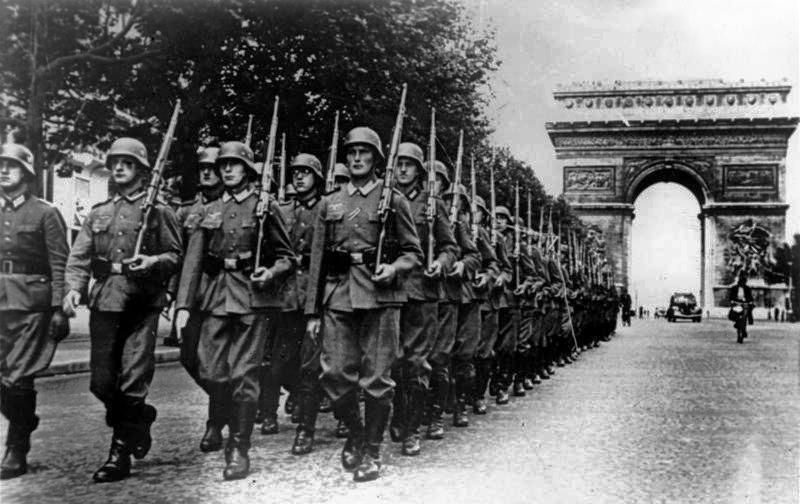
With the BEF gone and the best French armies destroyed in Belgium, the Germans turned south on June 5 to finish the job (Case Red).
8.1. The Weygand Line
General Maxime Weygand attempted to set up a defense in depth (the “Weygand Line”) along the Somme. He ordered troops to hold “hedgehog” positions even if bypassed.
-
The Reality: He had no reserves. The front was longer than the Maginot Line, but he had half the troops. The Germans punched through, and the retreat turned into a rout.
8.2. Italy’s “Stab in the Back”
On June 10, Benito Mussolini declared war. The Italian attack through the Alps was a fiasco—halted by a handful of French mountain troops—but legally and politically, it signaled the end.
IMAGE SUGGESTION 8
Subject: German Troops Crossing the Somme
Description: German infantry crossing the Somme river in assault boats or crossing a destroyed bridge during Case Red.
Caption: “Case Red: The exhausted French army, stripped of its armor, could not hold the extended Weygand Line.”
9. Political Disintegration and Armistice
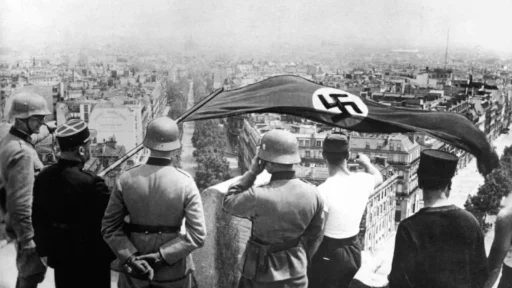
The military defeat triggered a total political collapse. Prime Minister Paul Reynaud resigned on June 16, replaced by Marshal Pétain.
9.1. The Armistice at Compiègne
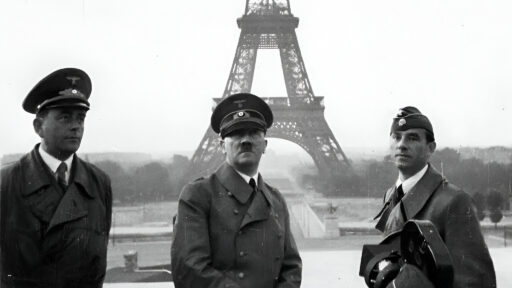
Hitler orchestrated a humiliation. On June 22, 1940, the Armistice was signed in the same railway carriage where Germany had surrendered in 1918.
-
The Terms: Germany occupied the north and west (Atlantic coast). Pétain retained a “Free Zone” in the south (Vichy France) and kept control of the French Navy and colonies. The French Army was reduced to 100,000 men.
IMAGE SUGGESTION 9
Subject: Hitler at the Compiègne Wagon
Description: The famous photo of Hitler standing in front of the railway carriage at Compiègne, hands on hips, viewing the statue of Foch.
Caption: “The Theater of Revenge: Hitler dictated the armistice terms in the exact spot of Germany’s 1918 humiliation.”
10. Conclusion: The “Strange Defeat”
Historian Marc Bloch called it a “Strange Defeat” (L’Étrange Défaite). It was not a defeat of courage, but of intellect and doctrine. The French Army was built for the slow, methodical war of 1918; the Wehrmacht fought the war of 1940.
The Fall of France fundamentally altered the 20th century: it left Britain isolated, emboldened Japan to expand in the Pacific, and convinced Stalin to accelerate Soviet rearmament. The blitzkrieg that conquered France in six weeks created a myth of German invincibility that would only be broken in the snows of Russia.
IMAGE SUGGESTION 10
Subject: The Partition Map of France
Description: A map showing the Occupied Zone (North/West) and the Free Zone (Vichy), with the demarcation line.
Caption: “A Divided Nation: The armistice partitioned France, leaving the industrial north under German occupation and the south under the Vichy regime.”
References and Further Reading
-
Primary Source (Memoir): Bloch, Marc. Strange Defeat: A Statement of Evidence Written in 1940. W.W. Norton & Company. (The definitive contemporary analysis).
-
German Operational Plan: Frieser, Karl-Heinz. The Blitzkrieg Legend: The 1940 Campaign in the West. Naval Institute Press. (The Official German history).
-
Comprehensive History: Jackson, Julian. The Fall of France: The Nazi Invasion of 1940. Oxford University Press. (The standard academic text).
-
Military Analysis: Doughty, Robert A. The Seeds of Disaster: The Development of French Army Doctrine, 1919-1939. Stackpole Books. (Analysis of “Methodical Battle”).
-
Technical Data (Tanks): The Tank Museum (Bovington). Char B1 bis. (Technical specs and history).
-
Battle of Arras: Bond, Brian. The Battle of France and Flanders 1940. Pen & Sword.
-
Primary Documents: Yale Avalon Project. Franco-German Armistice: June 22, 1940. (Full text of the armistice).
-
Biography: Citino, Robert M. The German Way of War: From the Thirty Years’ War to the Third Reich. University Press of Kansas.
-
Air War: Hooton, E.R. Luftwaffe at War: Blitzkrieg in the West. Chevron/Ian Allan.
-
Official US History: US Army Center of Military History. The German Campaign in the West 1940. (PDF analysis).
-
Dunkirk: Lord, Walter. The Miracle of Dunkirk. Penguin Books.
-
Maginot Line: Kaufmann, J.E. The Maginot Line: History and Guide. Pen & Sword.