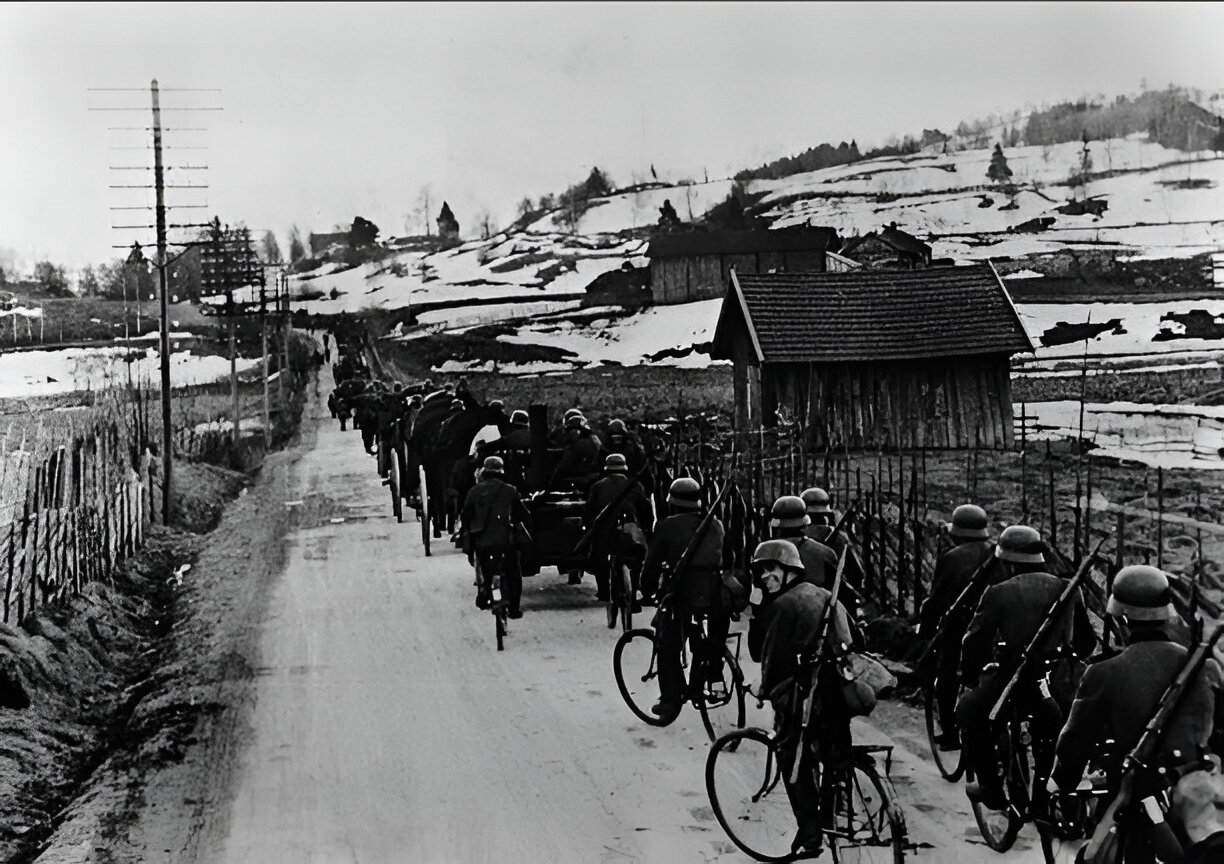

Operation Weserübung: The Scandinavia Campaign and the First Joint Operation of Modern Warfare, 1940
Executive Summary
On April 9, 1940, the “Phoney War” came to an abrupt and violent end with the launch of Operation Weserübung (Unternehmen Weserübung). This was Nazi Germany’s invasion of Denmark and Norway, a campaign that remains a case study in operational daring and the synchronization of sea, air, and land forces (Joint Operations). Triggered by the strategic necessity of securing Swedish iron ore supplies and preempting a planned Franco-British occupation, the campaign resulted in a decisive German strategic victory, albeit at a crippling cost to the Kriegsmarine surface fleet. This article dissects the strategic imperatives, the chaotic naval battles of Narvik, the ineptitude of the Allied response, and the political earthquake in London that toppled Neville Chamberlain and brought Winston Churchill to power.
1. Strategic Context: The Iron Ore Dilemma
To understand why the war moved north, one must look at the geology of the Scandinavian peninsula. The German war machine was utterly dependent on high-grade iron ore to produce steel for Panzers, artillery, and U-boats.
-
The Source: Germany imported nearly 11 million tons of iron ore annually from the Kiruna and Gällivare mines in neutral Sweden.
-
The Route: In summer, the ore was shipped via the Swedish port of Luleå in the Baltic Sea, safe from the Royal Navy. However, in winter, the Gulf of Bothnia froze. The ore then had to be transported by rail across the mountains to the ice-free Norwegian port of Narvik.
-
The Vulnerability: This route ran through Norwegian territorial waters (the “Leads”). Winston Churchill, then First Lord of the Admiralty, argued relentlessly for mining these waters (Operation Wilfred) to cut the “German lung.”
1.1. The Altmark Incident
The catalyst for the invasion was the Altmark Incident on February 16, 1940. The German tanker Altmark, carrying 299 British POWs captured by the Graf Spee, was cornered in neutral Norwegian waters by the British destroyer HMS Cossack.
-
The Action: A British boarding party stormed the ship, killed seven German sailors, and rescued the prisoners, shouting the famous line: “The Navy’s here!”
-
The Consequence: For Hitler, this proved that Norway was incapable of defending its neutrality and that Britain was willing to violate it. He ordered General Nikolaus von Falkenhorst to prepare an immediate invasion plan to secure the northern flank before the Allies did.
IMAGE SUGGESTION 1
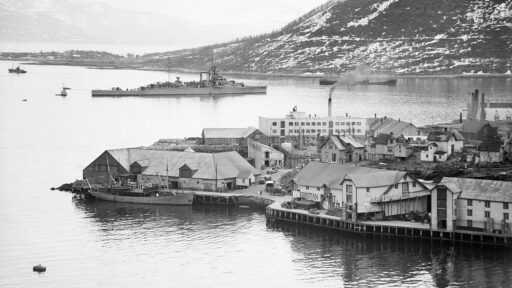
Subject: The Iron Ore Port of Narvik
Description: A historical photo of the ore loading docks in Narvik, showing trains dumping ore into transport ships. The snowy, mountainous terrain looms in the background.
Caption: “The Prize: The ice-free port of Narvik was the jugular vein of the German steel industry during winter.”
2. The Operational Plan: Weserübung Nord and Süd
Weserübung was the first true “Joint Operation” (Wehrmachtführungsstab) in history, requiring the seamless integration of the Navy, Army, and Air Force. It was a high-risk gamble; the German fleet had to transport troops across the North Sea in the face of absolute British naval superiority.
2.1. Weserübung Süd (Denmark)
The objective was to capture airfields in Jutland (specifically Aalborg) to serve as stepping stones for the Luftwaffe to reach Norway.
-
Force: Small motorized units and the first operational use of paratroopers (Fallschirmjäger).
2.2. Weserübung Nord (Norway)
The plan called for simultaneous amphibious landings at six major Norwegian ports: Oslo, Kristiansand, Stavanger, Bergen, Trondheim, and Narvik.
-
The Gamble: To reach Narvik, German destroyers carrying mountain troops (Gebirgsjäger) had to sail over 1,000 miles, directly through the Royal Navy’s patrol zones. Grand Admiral Erich Raeder warned Hitler that the operation might cost the entire surface fleet, but the strategic necessity outweighed the risk.
IMAGE SUGGESTION 2
Subject: Operation Weserübung Map
Description: A strategic map showing the multiple simultaneous German landings (arrows pointing to Oslo, Kristiansand, Bergen, Trondheim, Narvik) and the paratrooper drops in Denmark.
Caption: “The Great Gamble: German forces struck six targets simultaneously, stretching their naval logistics to the breaking point.”
3. The Six-Hour War: The Invasion of Denmark
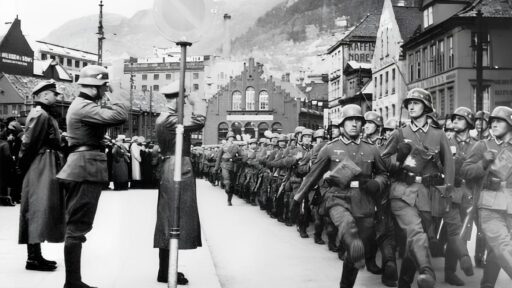
On April 9, 1940, at 04:15, German forces crossed the Danish border.
-
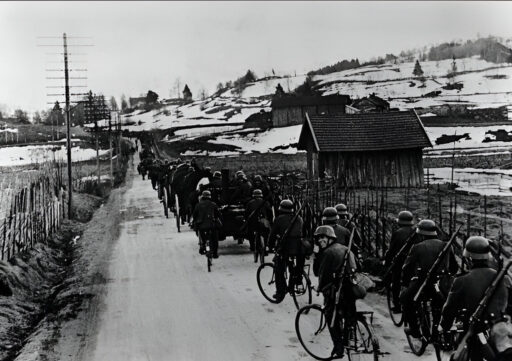
Land: Motorized columns raced north.
-
Sea: The troopship Hansestadt Danzig docked in Copenhagen harbor, dismounting a battalion of infantry who quickly seized the Citadel.
-
Air: The Luftwaffe threatened to bomb Copenhagen.
-
Surrender: Realizing resistance was futile and suicidal, King Christian X and the Danish government surrendered after brief skirmishes. The entire country was occupied in less than six hours, providing Germany with a “model protectorate” and vital airbases.
IMAGE SUGGESTION 3
Subject: German Troops in Copenhagen
Description: German soldiers on motorcycles or marching past bewildered Danish civilians and police officers in Copenhagen.
Caption: “The Six-Hour War: Denmark fell before noon, providing the Luftwaffe with vital airfields to strike Norway.”
4. The Invasion of Norway: Success and Disaster
The invasion of Norway was far more chaotic. While the Germans achieved surprise, they faced fierce local resistance and the wrath of the Royal Navy.
4.1. The Sinking of the Blücher
The German naval task force (Group 5) sent to capture the capital, Oslo, was led by the brand-new heavy cruiser Blücher.
-
The Ambush: As the fleet entered the narrow Drøbak Sound in the Oslofjord at 04:21, the 64-year-old guns of the Oscarsborg Fortress, commanded by Colonel Birger Eriksen, opened fire.
-
The Impact: Two 28cm shells hit the Blücher, followed by two torpedoes from a shore-based battery. The cruiser capsized and sank, taking over 800 sailors and Gestapo administrators to the bottom.
-
The Consequence: The sinking delayed the capture of Oslo by 12 hours. This critical delay allowed the Norwegian Royal Family and the gold reserves to escape the capital by train, preventing a total political decapitation.
IMAGE SUGGESTION 4
Subject: The Sinking of the Blücher
Description: An artistic rendering or the famous photo of the Blücher capsizing in the Oslofjord, smoke billowing, with sailors jumping into the icy water.
Caption: “Old Guns, New Ship: The sinking of the Blücher by 19th-century coastal guns saved the Norwegian King from capture.”
4.2. The Capture of Narvik
In the far north, ten German destroyers commanded by Commodore Friedrich Bonte landed 2,000 mountain troops (under General Eduard Dietl) at Narvik. They quickly sank the antiquated Norwegian coastal defense ships Eidsvold and Norge, killing nearly 300 Norwegian sailors, and seized the town. However, the German destroyers were now low on fuel and trapped in the fjord.
5. The Empire Strikes Back: The Battles of Narvik
The Royal Navy reacted with fury. The isolation of the German destroyer flotilla at Narvik presented a perfect target.
5.1. First Battle of Narvik (April 10)
A British flotilla of five destroyers, led by Captain Warburton-Lee in HMS Hardy, entered the fjord in a blinding snowstorm. They surprised the Germans, sinking two destroyers and damaging others. Both Warburton-Lee and the German commander Bonte were killed.
5.2. Second Battle of Narvik (April 13)
Three days later, the Royal Navy returned with overwhelming force: the battleship HMS Warspite escorted by nine destroyers.
-
The Massacre: The Warspite’s massive 15-inch guns thundered in the narrow confines of the fjord. The Swordfish floatplane from Warspite even sank a U-boat (U-64).
-
The Result: All eight remaining German destroyers were sunk or scuttled. The crews fled into the mountains, joining the infantry. It was a tactical triumph for Britain but a strategic dead end, as they failed to land troops immediately to retake the town.
IMAGE SUGGESTION 5
Subject: HMS Warspite at Narvik
Description: A dramatic painting or photo of the battleship HMS Warspite firing her broadside within the narrow, snow-covered fjord, dwarfing the surrounding destroyers.
Caption: “The Warspite Effect: The Royal Navy annihilated the German destroyer force at Narvik, trapping General Dietl’s troops.”
6. The Allied Land Campaign: A Study in Ineptitude
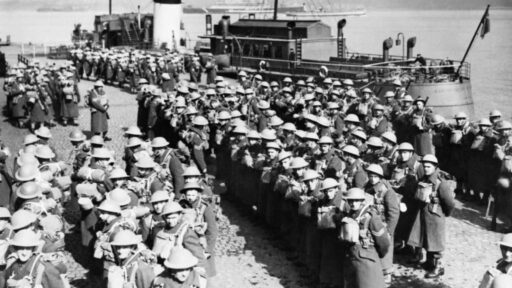
Following the naval engagements, the Allies (British, French, and Polish forces) landed troops at Namsos and Åndalsnes (central Norway) to retake Trondheim, and at Narvik in the north.
6.1. The Failure of Coordination
The Allied campaign was plagued by a chaotic command structure.
-
Lack of Air Cover: The Allies had no airfields. They attempted to operate Gloster Gladiator fighters from the frozen Lake Lesjaskogsvatnet, but the Luftwaffe bombed the ice, destroying the squadron.
-
Equipment Mismatch: British troops arrived without skis, snowshoes, or white camouflage. They were road-bound and decimated by German mortars and air attacks in the deep snow.
-
Retreat: By early May, the positions in central Norway were untenable. The Allies evacuated Namsos and Åndalsnes, leaving the Norwegian Army to surrender in the south.
6.2. The Battle for Narvik (Land)
In the north, the situation was different. Allied forces (including the French Foreign Legion and the Polish Independent Highland Brigade) successfully pushed General Dietl’s Germans back toward the Swedish border. On May 28, the Allies actually recaptured Narvik—the first major Allied land victory of the war.
-
The Bittersweet End: However, by late May, the situation in France (the German invasion of May 10) was catastrophic. The Allies needed every soldier back home. On June 8, they evacuated Narvik, blowing up the port facilities but handing the victory back to the Germans.
IMAGE SUGGESTION 6
Subject: Allied Troops in Snow
Description: British or French troops wading through deep snow without skis, looking exhausted and ill-equipped.
Caption: “Unprepared for Winter: Allied troops lacked skis and winter training, leaving them vulnerable to the mobile German Gebirgsjäger.”
7. Air Power: The Decisive Factor
Operation Weserübung proved definitively that naval power could not operate freely without air superiority.
-
X Fliegerkorps: The Luftwaffe deployed over 1,000 aircraft. They controlled the skies completely.
-
Sinking Ships: Luftwaffe bombers sank the British cruiser HMS Curacoa and the destroyer HMS Gurkha. They made the Royal Navy’s operations in the south of Norway impossible.
-
Transport: The German Ju 52 transport fleet was the logistical backbone, flying in reinforcements and supplies when the sea routes were cut.
IMAGE SUGGESTION 7
Subject: Luftwaffe Ju 52 Transports
Description: A photo of Ju 52 transport planes landed on a frozen lake or the captured Fornebu airfield, unloading troops and supplies.
Caption: “The Air Bridge: The Luftwaffe’s transport capability kept German forces supplied when the Royal Navy cut the sea lanes.”
8. Political Fallout: “In the Name of God, Go!”
The military failure in Norway triggered a political earthquake in London.
8.1. The Norway Debate
On May 7-8, 1940, the House of Commons held the Norway Debate. It was nominally about the retreat from Narvik, but effectively a referendum on Prime Minister Neville Chamberlain’s leadership.
-
Leo Amery: Conservative MP Leo Amery delivered a devastating speech, quoting Oliver Cromwell: “You have sat too long here for any good you have been doing. Depart, I say, and let us have done with you. In the name of God, go!”
-
Churchill’s Rise: Chamberlain resigned on May 10, the same day Germany invaded France. Winston Churchill formed a coalition government. Thus, the tactical defeat in Norway led directly to the strategic victory of installing Britain’s wartime leader.
8.2. Vidkun Quisling
In Norway, the invasion saw the rise of Vidkun Quisling, a fascist politician who declared a coup d’état over the radio on the first day of the invasion. His surname became a universal synonym for “traitor.” However, he was initially so incompetent that the Germans sidelined him, only reinstalling him later as a puppet leader.
IMAGE SUGGESTION 8
Subject: The Norway Debate in Parliament
Description: An illustration or photo of the crowded House of Commons during the debate. Chamberlain looks beleaguered on the front bench.
Caption: “Political Earthquake: The military disaster in Norway forced the resignation of Neville Chamberlain and the rise of Winston Churchill.”
9. The Strategic Counter-Move: Operation Fork
Fearing that the fall of Denmark would leave Iceland vulnerable to a German takeover (which would threaten the Atlantic convoys), Britain launched Operation Fork.
-
Invasion of Iceland: On May 10, 1940, Royal Marines landed in Reykjavik. It was a polite invasion; the Icelandic government protested neutrality but did not resist. Britain (and later the US) occupied the island, securing a vital air and naval base for the Battle of the Atlantic.
10. The Naval Balance Sheet: A Pyrrhic Victory?
Germany secured the iron ore and established bases that extended U-boat range by 1,000 miles. However, the cost to the Kriegsmarine was catastrophic.
-
German Losses: 1 heavy cruiser (Blücher), 2 light cruisers (Königsberg, Karlsruhe), 10 destroyers, and 4 U-boats.
-
Strategic Impact: The German surface fleet was effectively crippled. When the invasion of France concluded and the invasion of Britain (Operation Sea Lion) was proposed, the Kriegsmarine had virtually no surface ships left to escort the landing fleet. The victory in Norway made the invasion of England impossible.
IMAGE SUGGESTION 9
Subject: Map of U-Boat Range Extension
Description: A map of the Atlantic showing U-boat operational ranges from German bases vs. U-boat ranges from the new Norwegian bases (Bergen, Trondheim). The new arcs cover the North Atlantic convoy routes.
Caption: “Atlantic Threat: Bases in Norway allowed U-boats to strike deeper into the Atlantic, flanking the British blockade.”
11. Conclusion: The Lessons of the North
The Scandinavia Campaign was a watershed moment in military history. It demonstrated:
-
Joint Operations: Success requires the tight integration of land, sea, and air forces.
-
Air Superiority: Surface ships, no matter how powerful, are vulnerable without air cover.
-
Strategic Trade-offs: Germany traded its fleet for resources and geography. Britain traded a tactical defeat for a political renewal.
While the swastika flew over Oslo and Copenhagen, the destruction of the German destroyers at Narvik echoed down the years, saving Britain from invasion later that summer.
IMAGE SUGGESTION 10
Subject: King Haakon VII
Description: The famous photo of King Haakon VII and the Crown Prince taking shelter under a birch tree during a German air raid while fleeing north.
Caption: “Symbol of Resistance: King Haakon VII refused to surrender, eventually establishing a government-in-exile in London.”
References and Further Reading
-
Naval History: Haarr, Geirr H. The German Invasion of Norway, April 1940. Seaforth Publishing. (The definitive naval history of the campaign).
-
Operational Analysis: Zabecki, David T. Germany at War: 400 Years of Military History. ABC-CLIO. (Detailed analysis of Weserübung).
-
Primary Source (Debate): UK Parliament. Hansard: The Norway Debate, May 1940. (Verbatim transcript).
-
Campaign History: Adams, Jack. The Doomed Expedition: The Campaign in Norway, 1940. Pen & Sword.
-
Technical Data: German Naval History. Heavy Cruiser Blücher. (Technical specifications and operational history).
-
Strategic Context: Lunde, Henrik O. Hitler’s Pre-Emptive War: The Battle for Norway, 1940. Casemate. (Analysis from an American-Norwegian perspective).
-
Political History: Kersaudy, Francois. Norway 1940. University of Nebraska Press. (Focuses on the diplomatic and political failures of the Allies).
-
Museum Resource: Narvik War Museum. Battle of Narvik History.
-
Air Power: Corum, James S. The Luftwaffe: Creating the Operational Air War, 1918-1940. University Press of Kansas.
-
Archive: US Naval History and Heritage Command. The Campaign in Norway.