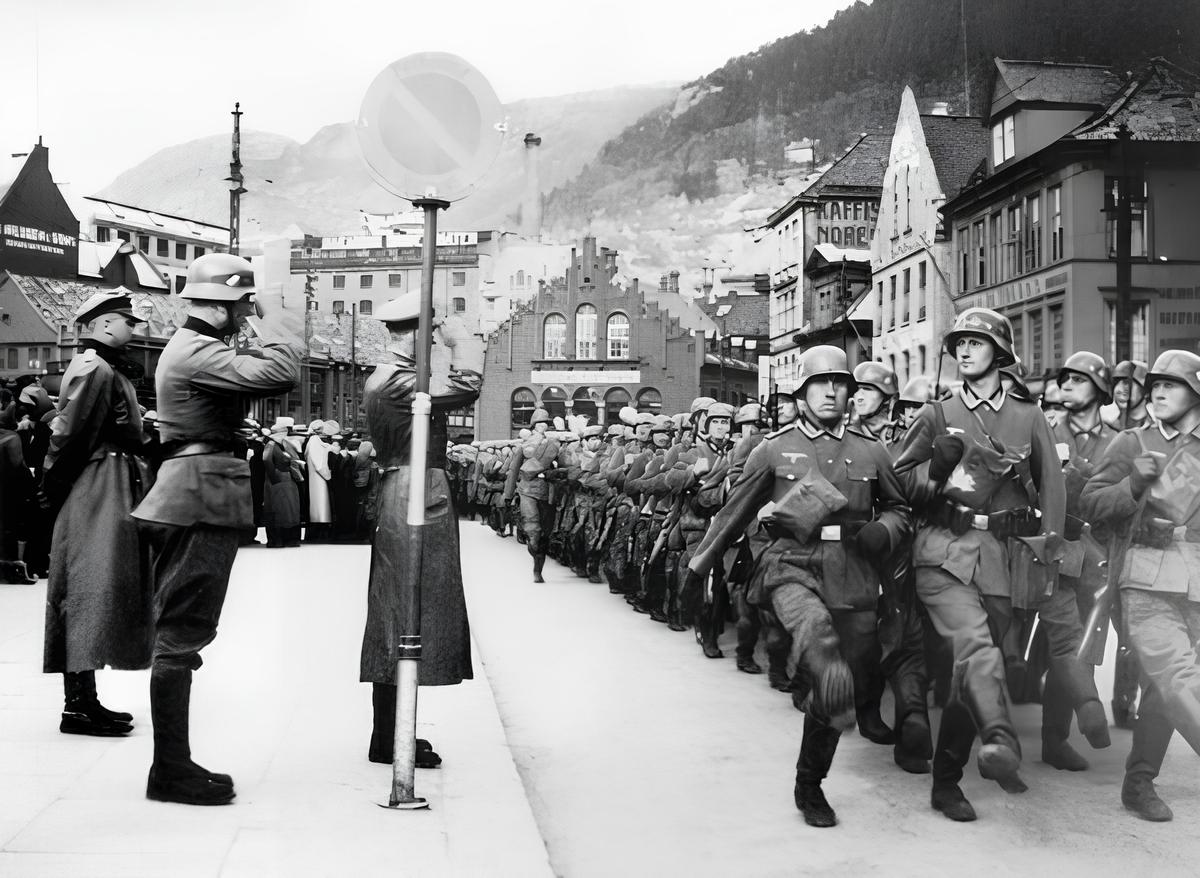

The Iron Road: The Geopolitical, Metallurgical, and Strategic Centrality of Scandinavia, 1939–1940
Executive Summary
While the popular narrative of World War II often focuses on the ideological clashes of the main belligerents, the initial expansion of the war into Scandinavia was driven by cold, hard geology. The German war machine, the Wehrmacht, was an industrial giant built on a fragile foundation: a critical lack of high-grade iron ore. In 1939, nearly 50% of the ore needed to feed the blast furnaces of the Ruhr came from neutral Sweden. During the winter months, when the Baltic Sea froze, this lifeline depended entirely on a single rail line crossing the mountains to the ice-free Norwegian port of Narvik. This dependency turned the remote Scandinavian peninsula into the “jugular vein” of the Third Reich. This article dissects the metallurgy of the German war economy, the logistical nightmare of the “Iron Road,” the secret sabotage plans of British intelligence, and the deadly game of naval chess played by Britain and Germany to control it.
1. Introduction: The Chemistry of Dependency
To understand the “Strategic Paralysis” of Germany regarding Norway, one must move beyond general military history and understand the metallurgy of the Third Reich. Steel is the skeleton of modern warfare. It forms the hulls of battleships, the armor of Panzers, and the casings of artillery shells. In 1939, Germany was the second-largest steel producer in the world, but it was geologically destitute.
1.1. Magnetite vs. Minette
Germany controlled the Lorraine region (France) and had domestic mines (Salzgitter). However, these sources produced Minette ore.
-
The Chemical Flaw: Minette ore has a low iron content (typically 25-30%). To produce one ton of steel from Minette, a blast furnace requires significantly more coke (coal) to burn off the impurities (slag).
-
The Kiruna Difference: The Swedish ore from Kiruna and Gällivare is Magnetite ($Fe_3O_4$). It possesses an exceptionally high iron content of 60-70%.
-
The Coke Crisis: Germany was perpetually short of coking coal. Using Swedish high-grade ore essentially “doubled” the efficiency of German blast furnaces. Without it, the German coal supply lines would have collapsed under the weight of processing vast amounts of low-grade domestic rubble.
1.2. The Thomas-Gilchrist Lock-in
The Swedish ore was high in phosphorus. Historically, this was a defect, but the German steel industry in the Ruhr had specifically adapted its mills using the Thomas-Gilchrist process (basic bespoke converters) to utilize high-phosphorus ore.
-
The Strategic Trap: By 1939, the Ruhr industrial complex was technologically “locked in” to the specific chemical composition of Swedish ore. They could not simply switch to other sources overnight without rebuilding the refractory lining of their blast furnaces—a downtime Germany could not afford in the middle of a war. Grand Admiral Erich Raeder bluntly informed Hitler: “Without Swedish ore, the German war industry will grind to a halt within six months.”
IMAGE SUGGESTION 1
Subject: Thomas-Gilchrist Converter in a Ruhr Steel Mill
Description: A historical photo or technical diagram of a massive Bessemer/Thomas converter in operation at a Krupp factory. Sparks flying, showing the scale of the industrial machinery dependent on this specific ore chemistry.
Caption: “Chemical Captivity: The German steel industry was technologically calibrated for high-phosphorus Swedish ore, making the supply chain existential.”
2. The Logistics of Vulnerability: The Winter Problem
The transport of this vital ore was dictated entirely by the climate of the Arctic Circle. The supply chain had two distinct modes, creating a seasonal vulnerability.
2.1. The Summer Route (The Baltic Lake)
From May to November, the Baltic Sea was open. Ore trains moved south from the mines to the Swedish port of Luleå on the Gulf of Bothnia. From there, German ships carried it safely across the Baltic Sea to German ports like Stettin or Hamburg. Since the German Navy controlled the Baltic, this route was immune to British interference.
2.2. The Winter Route (The Danger Zone)
From December to April, the low-salinity water of the Gulf of Bothnia froze solid, closing the port of Luleå. The only alternative was to move the ore west.
-
The Ofoten Line: The ore had to be transported by the Ofoten Railway (Malmbanan), an engineering marvel electrified to handle heavy loads, running through the mountains to the Norwegian port of Narvik.
-
The Ice-Free Prize: Thanks to the Gulf Stream, Narvik remains ice-free year-round. However, to get the ore from Narvik to Germany, ships had to travel 1,000 miles south down the Norwegian coast, exposing them to the Royal Navy.
IMAGE SUGGESTION 2
Subject: Strategic Map of Iron Ore Routes
Description: A map highlighting the two routes: the “Summer Route” from Luleå through the Baltic (marked Safe/Green), and the “Winter Route” from Narvik down the Norwegian coast (marked Vulnerable/Red). The frozen area of the Gulf of Bothnia should be visually distinct.
Caption: “The Winter Crisis: When the Baltic froze, Germany’s industrial survival depended entirely on the exposed railway to Narvik.”
3. The “Leads”: A Geopolitical Loophole
The geography of the Norwegian coastline provided a unique shield for German shipping, known as the “Leads” (Indreleia).
3.1. The Covered Way
The Norwegian coast is shielded by a continuous chain of roughly 50,000 offshore islands and skerries. Between these islands and the mainland lies a sheltered, deep-water channel.
-
The Legal Shield: As long as German ore ships stayed within these territorial waters, they were protected by Norway’s neutrality. The Royal Navy could not legally attack them without violating international law. German captains hugged the coast, only darting out into open water for short, unavoidable stretches (like the Hustadvika).
3.2. Churchill’s Obsession
Winston Churchill, then First Lord of the Admiralty, viewed this as an intolerable loophole. He argued that legal niceties should not prevent Britain from cutting the enemy’s lifeline. He famously wrote to the War Cabinet, “We are fighting to re-establish the reign of law… but we must not allow the enemy to use the law to destroy us.” Churchill proposed mining these waters to force German ships out into the open sea where they could be sunk.
IMAGE SUGGESTION 3
Subject: The Norwegian Leads Geography
Description: An aerial photo or diagram showing a ship sailing through the “Leads”—protected by islands on one side and the jagged mainland on the other, illustrating how they hid from the Royal Navy.
Caption: “The Covered Way: The ‘Leads’ allowed German ships to travel the entire length of Norway protected by neutral waters.”
4. The Altmark Incident and Operation Wilfred
The theoretical vulnerability of the ore route became a kinetic reality in early 1940.
4.1. The Altmark Incident
On February 16, 1940, the German tanker Altmark, carrying 299 British POWs captured by the Graf Spee, was cornered in neutral Norwegian waters (Jøssingfjord) by the British destroyer HMS Cossack.
-
The Action: A British boarding party stormed the ship, killed seven German sailors, and rescued the prisoners.
-
The Consequence: For Hitler, this was the tipping point. It proved that Norway was incapable of defending its neutrality and that Britain was willing to violate it. He ordered General Nikolaus von Falkenhorst to prepare an immediate invasion plan (Operation Weserübung) to secure the northern flank before the Allies did.
4.2. Operation Wilfred
Simultaneously, Churchill finally got approval for Operation Wilfred, named after the comic strip character because the operation was “so small and innocent.”
-
The Mines: On April 8, 1940, the Royal Navy began laying minefields in the Vestfjord leading to Narvik. The goal was to block the ore traffic.
-
The Timing: It was too late. The very next day, April 9, the German invasion fleet sailed past the British minelayers in the fog.
IMAGE SUGGESTION 4
Subject: The Altmark in Jøssingfjord
Description: A photo of the tanker Altmark trapped in the ice of the Jøssingfjord, with the HMS Cossack alongside it.
Caption: “The Catalyst: The boarding of the Altmark convinced Hitler that the neutral corridor was no longer safe.”
5. The Battle for the Railway: Narvik as the Bullseye
The subsequent Battle of Narvik was fought exclusively for the control of the Ofoten Railway. It was the only reason military forces were operating so far north of the Arctic Circle.
5.1. The German Isolation
General Eduard Dietl’s mountain troops (Gebirgsjäger) captured Narvik but were immediately cut off when the Royal Navy annihilated the German destroyer fleet in the fjord. Dietl’s troops were forced to retreat along the railway line toward the Swedish border.
-
The Terrain: The fighting took place in deep snow, on steep cliffs where the railway was the only flat ground. Possession of the tunnels and bridges became the tactical objective.
5.2. Destruction of the Facilities
The Allies (British, French, and Polish) eventually recaptured Narvik on May 28, 1940. However, the collapsing situation in France forced them to evacuate days later. Before leaving, Allied engineers systematically destroyed the massive ore loading docks and electric power stations of Narvik.
-
The Impact: It took Germany seven months to repair the port facilities. During that time, ore exports from Narvik dropped to zero. However, by January 1941, the flow resumed.
IMAGE SUGGESTION 5
Subject: The Ofoten Railway in Winter
Description: A photo of a heavy ore train moving through the snowy mountains on the Ofoten line. The harsh conditions underscore the logistical difficulty.
Caption: “The Iron Artery: The Ofoten Railway was the sole link between the Swedish mines and the winter port of Narvik.”
IMAGE SUGGESTION 6
Subject: Ruined Docks of Narvik (1940)
Description: A photo of the destroyed ore loading piers in Narvik after the Allied evacuation. Twisted metal and sunken ships blocking the harbor.
Caption: “Scorched Earth: Allies destroyed the Narvik docks before retreating, pausing the ore flow for seven months.”
6. Swedish Neutrality: The Wallenberg Connection
Sweden was in the most precarious position. It supplied the ore but was surrounded by war. The flow of ore was facilitated by a complex diplomatic and financial dance, led by the Wallenberg family.
6.1. The Enskilda Bank Strategy
Jacob and Marcus Wallenberg, controlling Stockholms Enskilda Bank, negotiated trade agreements between Nazi Germany and Great Britain simultaneously.
-
Gold for Iron: Germany, lacking foreign currency, began paying for ore with gold—often looted gold from the central banks of occupied Belgium and the Netherlands. The Wallenbergs accepted this gold to keep the Swedish economy afloat, a controversial act of “neutrality.”
-
The “Bosch Affair”: To protect German assets, the Wallenbergs helped German companies (like Bosch) cloak their foreign subsidiaries as “Swedish” entities to avoid Allied seizure.
6.2. Permittenttrafik (The Transit Traffic)
Under immense German pressure, Sweden allowed “leave trains” (permittenttrafik) to transport German soldiers and supplies through neutral Swedish territory to Narvik and Finland.
-
The Rationalization: The Swedish government argued this was necessary to avoid invasion. While technically neutral, the Swedish rail network became an integrated part of German logistics in the North.
IMAGE SUGGESTION 7
Subject: Kiruna Iron Mine
Description: An open-pit or underground mine entrance in Kiruna during the 1940s. Showing massive machinery and the scale of the operation.
Caption: “Feeding the Beast: The Kiruna mines provided the raw material for 50% of the German war machine.”
7. Operation Paul: The Secret Plan to Bomb the Mines
While the public war focused on Narvik, British intelligence (MI6) and the Ministry of Economic Warfare formulated a more direct, darker plan: Operation Paul.
7.1. The Sabotage Blueprint
The plan involved a carrier-based airstrike or a commando raid directly against the mining infrastructure in Luleå and Kiruna, inside neutral Sweden.
-
Targets: The primary targets were the massive ore loading hoists, the electric transformers powering the rail line, and the crushing plants. These were custom-built engineering feats that would take years to replace.
-
The Constraint: Destroying the mines would violate Swedish neutrality and likely drive Sweden to formally join the Axis. The British War Cabinet debated this endlessly.
-
Execution: Ultimately, the operation was canceled due to the lack of long-range bombers and the fear of political fallout. However, SOE (Special Operations Executive) agents were infiltrated into Sweden to monitor train movements and prepare for potential sabotage of the Luleå harbor gates.
IMAGE SUGGESTION 8
Subject: Luleå Ore Docks
Description: A photo of the massive ore loading elevators at the port of Luleå in the 1940s. These engineering behemoths were the specific targets of the cancelled Operation Paul.
Caption: “Target Luleå: British planners considered bombing these massive loading docks to permanently sever the ore link.”
8. Unintended Consequences: The Nortraship Miracle
The struggle for the iron ore route had an unintended consequence that ironically saved Britain. When Germany invaded Norway to secure the ore, they hoped to capture the massive Norwegian merchant fleet (the 4th largest in the world).
8.1. The Great Escape
King Haakon VII and the Norwegian government ordered all Norwegian ships at sea to proceed immediately to Allied ports.
-
Nortraship: This directive created Nortraship (The Norwegian Shipping and Trade Mission), the largest shipping company in the world, controlled by the Norwegian government-in-exile in London.
-
The Trade-off: While Germany got the iron ore, Britain gained 1,000 modern merchant ships and 30,000 experienced sailors. British historians admit that without the fast Norwegian tankers carrying aviation fuel in 1940, the Battle of Britain might have been lost. Germany secured its steel, but inadvertently gave Britain the logistics to survive.
IMAGE SUGGESTION 9
Subject: Norwegian Merchant Ship (Nortraship)
Description: A photo of a Norwegian tanker or cargo ship in a convoy, flying the Norwegian flag, perhaps with heavy seas.
Caption: “The Strategic Trade-off: Germany got the ore, but Britain got the fleet. Nortraship tankers fueled the RAF during the Battle of Britain.”
9. Fortress Norway: The Long-Term Cost
The obsession with Swedish ore dictated German naval and military strategy for the entire remainder of the war.
9.1. The Speer Assessment
German armaments minister Albert Speer later assessed the criticality of the ore. He argued that the invasion of Norway was strictly necessary in 1940. However, by 1943, as Germany conquered Ukraine (Krivoy Rog) and France, the Swedish ore became less volumetrically critical but remained qualitatively essential.
-
High-Tech Applications: Swedish ore was reserved for the production of the highest quality steels used in ball bearings (Schweinfurt) and synthetic fuel plant piping.
9.2. The Garrison Trap
To protect the ore route from Allied invasion, Hitler turned Norway into “Festung Norwegen” (Fortress Norway).
-
The Diversion: Germany kept nearly 400,000 troops stationed in Norway until May 1945. These were elite units that were desperately needed on the Eastern Front or in Normandy. Thus, the “Iron Road” not only started the war in the West but also helped bleed the Wehrmacht dry by tying down substantial forces in a strategic backwater.
IMAGE SUGGESTION 10
Subject: German Coastal Defenses in Norway
Description: A photo of a massive coastal gun battery (e.g., Batterie Vara or Møvik Fort) constructed by the Germans in Norway.
Caption: “Fortress Norway: 400,000 German troops remained in Norway to guard the ore route, a massive diversion of manpower.”
10. Conclusion: Geography is Destiny
The struggle for Norway and the Swedish iron ore proves that World War II strategy was often dictated by supply chains and geography rather than pure military prowess. The invasion of a peaceful, neutral country was rationalized by both sides (Allies and Axis) as a necessity of industrial survival.
The German victory in securing the ore was a tactical masterpiece but a strategic burden. The Kriegsmarine lost its surface fleet in the process, making an invasion of England impossible. The ore kept flowing—building the Tiger tanks and U-boats that prolonged the war—but the cost of protecting that flow helped ensure Germany’s ultimate defeat. As historian Adam Tooze notes, the Third Reich’s economy was always a house of cards, and Swedish iron was one of the few cards holding it up.
References and Further Reading
-
Economic History: Fritz, Martin. German Steel and Swedish Iron Ore 1939-1945. Institute of Economic History, Gothenburg University. (The definitive academic study on the ore trade).
-
Strategic Analysis: Tooze, Adam. The Wages of Destruction: The Making and Breaking of the Nazi Economy. Penguin Books. (Essential for understanding the resource economics).
-
Naval Campaign: Haarr, Geirr H. The Battle for Norway: April–June 1940. Seaforth Publishing. (Detailed naval operations analysis).
-
Primary Documents: Churchill, Winston. The Second World War, Vol. 1: The Gathering Storm. RosettaBooks. (Churchill’s own account of Operation Wilfred).
-
Corporate History: LKAB History. 125 Years of Mining. (Official history of the Swedish mining company).
-
Corporate Espionage: Aalders, Gerard. The Art of Cloaking Ownership: The Secret Collaboration and Protection of the German War Industry by the Neutrals. Amsterdam University Press. (Details the Wallenberg/Bosch affair).
-
Intelligence Operations: Cruickshank, Charles. SOE in Scandinavia. Oxford University Press. (Details on Operation Paul and sabotage attempts).
-
Maritime History: Moss, T. The World’s Largest Shipping Company: Nortraship 1940-1945. (Comprehensive history of the Norwegian fleet).
-
Diplomatic History: Gilmour, John. Sweden, the Swastika and Stalin. Edinburgh University Press. (Analysis of Swedish neutrality).
-
Museum Resource: The Narvik War Museum. The Narvik Campaign History.
-
Memoirs: Speer, Albert. Inside the Third Reich. Simon & Schuster.
-
Article: Naval War College Review. The Strategic Importance of the Norwegian Sea.