The Death of the Trench
When the Great War (World War I) ended in 1918, the enduring image of the Western Front was one of stagnation: lines of mud-filled trenches stretching from Switzerland to the North Sea, where armies bled each other dry for yards of ground. It was a war of static attrition.
However, the Second World War would be radically different. Between 1918 and 1939, military theorists—such as Guderian in Germany, de Gaulle in France, and Liddell Hart in Britain—envisioned a new kind of conflict. They realized that the internal combustion engine (tanks and trucks) and wireless communication (radios) could restore maneuver to the battlefield.
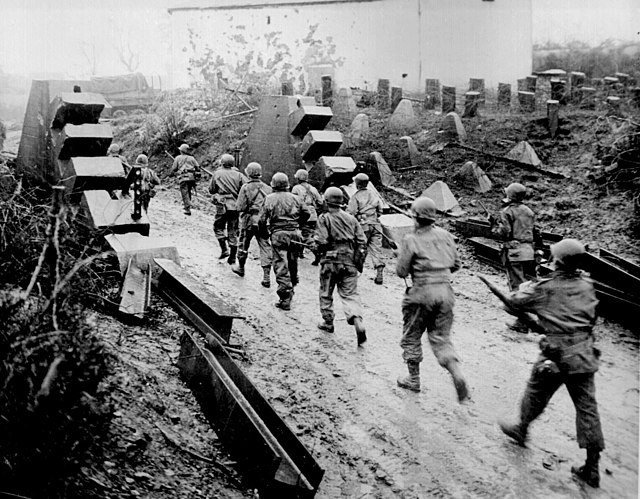
The Western Front of 1939–1945 became the proving ground for “Mobile Warfare.” It was a theater defined not by static lines, but by lightning-fast armored thrusts, encirclements, and the terrifying integration of air power with ground forces. It was the age of Blitzkrieg and the “dash to the wire.”
This article explores how the Western Front shattered the stalemate of the previous generation and revolutionized military doctrine forever.
[IMAGE 1 PLACEHOLDER: A comparison graphic or map showing the static trench lines of WWI versus the sweeping arrow movements of the 1940 invasion of France, illustrating the shift in doctrine.]
The Phony War and the Shock of Blitzkrieg (1939–1940)
When Britain and France declared war on Germany in September 1939, they expected a replay of WWI. They dug in behind the Maginot Line—a massive, impregnable system of fortifications along the French-German border—and waited. This period of inactivity became known as the “Phony War” (Sitzkrieg).
The Allies prepared for a long, defensive war. They believed that superior economic resources would eventually strangle Germany. They were wrong.
The Sickle Cut (Sichelschnitt)
In May 1940, Germany unleashed Fall Gelb (Case Yellow). Instead of attacking the Maginot Line head-on, or repeating the WWI Schlieffen Plan through northern Belgium, they did the impossible. They sent the bulk of their Panzer divisions through the Ardennes Forest—a region of dense woods and hills considered “impassable” for tanks by Allied planners.
This was Blitzkrieg (Lightning War) in its purest form. German columns, supported by screaming Stuka dive-bombers acting as flying artillery, punched through the weak French defenses at Sedan.
The Race to the Sea
Once through the line, the German Panzers did not stop to consolidate. They raced west across France, cutting the Allied armies in half. In just six weeks, the French Army—considered the finest in Europe—collapsed. The British Expeditionary Force (BEF) was forced to evacuate from Dunkirk, leaving their heavy equipment behind. Mobile warfare had defeated a static defense in spectacular fashion.
[IMAGE 2 PLACEHOLDER: A map of the “Manstein Plan” (Sichelschnitt), showing the German armored thrust through the Ardennes and the encirclement of Allied forces in Belgium.]
Fortress Europe and the Return (1940–1944)
For four years, the Western Front was defined by the English Channel. While the Soviet Union bore the brunt of the land war in the East, the Western Allies built a massive air and sea armada.
Hitler constructed the “Atlantic Wall,” a chain of coastal fortifications stretching from Norway to Spain. He was betting that he could turn the clock back to 1918—that a static defense on the beaches could stop an invasion.
D-Day: The Amphibious Hammer
On June 6, 1944 (Operation Overlord), the Allies proved that mobile warfare began at sea. It was the largest amphibious assault in history. Yet, the initial weeks in Normandy were surprisingly static. The “Bocage” country—ancient hedgerows that acted like natural fortresses—slowed the Allied advance to a crawl. For a month, it looked like the trench warfare of WWI had returned.
[IMAGE 3 PLACEHOLDER: An aerial view of the Normandy beaches on D-Day, showing the sheer scale of the landing craft and the logistics involved in breaching the Atlantic Wall.]
Operation Cobra and the Breakout (Summer 1944)
The stalemate was broken not by attrition, but by maneuver. On July 25, 1944, the Americans launched “Operation Cobra.” After a massive carpet-bombing campaign to shatter the German lines, General Omar Bradley’s forces punched a hole in the front.
Through this hole poured the US 3rd Army, commanded by the apostle of mobile warfare: General George S. Patton.
Patton’s Race
Patton did not care about flanks; he cared about speed. His tanks fanned out, encircling German armies and racing across France. The German army in the West collapsed in the “Falaise Pocket,” where thousands of troops were trapped and destroyed by Allied air power and artillery.
By August 1944, Paris was liberated. Allied tanks were often advancing so fast that they ran off their maps. The defining constraint of this phase was not enemy resistance, but logistics—specifically, gasoline. The “Red Ball Express,” a massive truck convoy system, worked 24/7 to feed the insatiable thirst of the Sherman and Cromwell tanks.
[IMAGE 4 PLACEHOLDER: A map of the “Falaise Pocket” showing the pincer movement of Canadian, British, and American forces trapping the German 7th Army.]
A Bridge Too Far – Airborne Mobility (September 1944)
Mobile warfare wasn’t just about tanks; it was about “Vertical Envelopment.” Field Marshal Bernard Montgomery proposed a daring plan to end the war by Christmas: Operation Market Garden.
The plan utilized the largest airborne drop in history. Three divisions of paratroopers would drop behind enemy lines in the Netherlands to seize key bridges over the Rhine, paving a “carpet” for British tanks to drive straight into the industrial heart of Germany.
It was a gamble on mobility. While the drops were successful, the ground forces could not move fast enough along the single, narrow highway to link up with the furthest paratroopers at Arnhem. The operation failed, proving that even mobile warfare has limits when logistics and terrain (and unexpected Panzer divisions) conspire against it.
[IMAGE 5 PLACEHOLDER: Paratroopers dropping from C-47 transport planes over the Netherlands during Operation Market Garden, filling the sky with chutes.]
The Battle of the Bulge – The Last Blitzkrieg (Winter 1944)
In December 1944, Hitler attempted to recreate the miracle of 1940. He stripped the Eastern Front of his last Panzer reserves and launched a surprise offensive through the snowy Ardennes.
His goal was to split the Allied armies and capture the port of Antwerp. The “Battle of the Bulge” was the largest battle fought by the US Army in WWII. Initially, the Germans achieved total surprise, creating a massive “bulge” in the Allied line.
However, 1944 was not 1940. The Allies had total air superiority (once the weather cleared) and their mobile reserves were faster. General Patton famously turned his entire 3rd Army ninety degrees in just a few days—a logistical miracle—to counter-attack the German flank and relieve the besieged town of Bastogne. The German tanks, running out of fuel and hammered by fighter-bombers, were forced to abandon their vehicles. It was the death rattle of the Wehrmacht in the West.
[IMAGE 6 PLACEHOLDER: American soldiers in winter gear fighting in the snow-covered forests of the Ardennes, with a tank in the background.]
Crossing the Rhine and the End (1945)
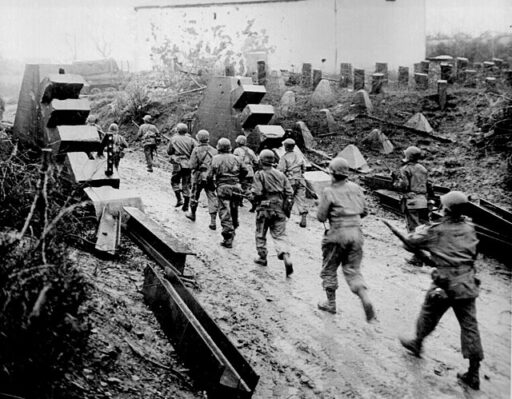
With the failure of the Bulge, the road to the Rhine was open. The Allies used their mobility to jump the final barrier. When the Americans found the Ludendorff Bridge at Remagen intact, they poured across it before the Germans could blow it up.
In March 1945, the Allies conducted “Operation Varsity,” another massive airborne drop to cross the Rhine. Once across, the Allied armies fanned out into Germany, encircling the industrial Ruhr Valley and trapping over 300,000 German soldiers.
The war in the West ended with Allied tanks meeting Soviet forces at the Elbe River in April 1945. The mobile warfare doctrine had totally dismantled the Third Reich.
[IMAGE 7 PLACEHOLDER: The Ludendorff Bridge at Remagen, showing American tanks and troops crossing the Rhine River while under fire.]
The Tools of Mobility
The success of mobile warfare on the Western Front relied on three pillars:
-
The Tank: From the Panzer IV to the M4 Sherman. The Sherman was not the most heavily armored tank, but it was mechanically reliable, fast, and could be produced in massive numbers. It was the perfect vehicle for exploitation and maneuver.
-
Air Power: The “Jabos” (Jagdpanzer/Fighter-Bombers) like the P-47 Thunderbolt and Hawker Typhoon acted as flying tanks. They disrupted enemy supply lines and smashed armor concentrations, ensuring the enemy could not move in daylight.
-
The Radio: In WWI, generals lost contact with their troops the moment they went “over the top.” In WWII, every tank had a radio. Commanders could coordinate artillery, air support, and infantry movements in real-time.
[IMAGE 8 PLACEHOLDER: A schematic or photo of a P-47 Thunderbolt or Hawker Typhoon conducting a ground attack run on a German convoy.]
Conclusion: The Legacy of the West
The Western Front from 1939 to 1945 proved that the era of static defense was over. The “Maginot Mentality” was dead. The victors were those who could integrate speed, communication, and logistics into a cohesive force.
The lessons learned here—Combined Arms operations, air-ground integration, and deep logistical strikes—formed the basis of modern military doctrine used by NATO and major powers to this day. The Western Front was where the blueprint for modern warfare was written in the tracks of the Sherman and the Panzer.
[IMAGE 9 PLACEHOLDER: A map showing the final convergence of Allied armies (Western Allies and Soviets) in central Germany in 1945.]
[IMAGE 10 PLACEHOLDER: A modern photo of the wreckage of a tank in a European museum or field, serving as a monument to the mobile battles of the past.]
References and Recommended Sources
-
Beevor, Antony. D-Day: The Battle for Normandy. Viking, 2009. (A masterclass in narrative history, covering the beach landings to the liberation of Paris).
-
Hastings, Max. Overlord: D-Day and the Battle for Normandy. Simon & Schuster, 1984. (Focuses on the operational challenges and the comparison between Allied and German soldiering).
-
Atkinson, Rick. The Guns at Last Light: The War in Western Europe, 1944-1945 (The Liberation Trilogy, Vol. 3). Henry Holt and Co., 2013. (The definitive American account of the final year of the war).
-
Ryan, Cornelius. A Bridge Too Far. Simon & Schuster, 1974. (The classic, minute-by-minute account of the failed Operation Market Garden).
-
Citino, Robert M. The Wehrmacht’s Last Stand: The German Campaigns of 1944-1945. University Press of Kansas, 2017. (An operational analysis of how the German army fought when outnumbered).
-
Imperial War Museums (IWM). “The Liberation of Europe”. (Official history and photo archives).
-
U.S. Army Center of Military History. European Theater of Operations. (The official “Green Books” detailing every aspect of the US Army’s campaign).